How concerned should we be?
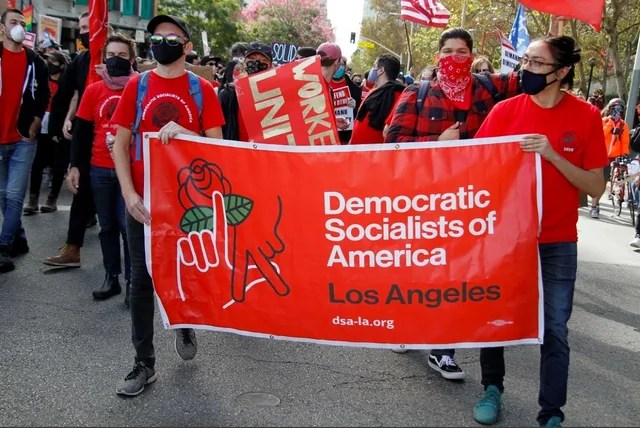
We really gonna do this, L.A.?
The rise of the “Democratic Socialists” (a contradiction in terms if ever there was one) of America, aka the DSA, in elections around the country, has the Democratic Party on the brink of political civil war. The most recent example came late Tuesday night, when insurgent DSA candidate Abdul El-Sayed defeated four term U.S. Representative Haley Stevens in the Michigan Democratic Senate primary. El-Sayed’s victory comes on the heels of other high profile DSA wins like Zorhan Mamdani in New York City and Katie Wilson in Seattle.
However, to understand what DSA governance looks like in practice, forget Michigan. Even if El-Sayed wins in November — which seems unlikely, given his less than one point margin of victory in his own party — he’ll join Bernie Sanders as two of 100. Forget Mamdani, who’s constrained by a coequal city council in which his Trotskyite fellow travellers hold just four of 51 seats, and by an entrenched city bureaucracy that acts as its own political counterbalance, albeit a bloated, inefficient one. Forget Wilson, who’s similarly restrained by council and who is just not very good at her job. Forget even AOC and Sanders, who bloviate and gesticulate, then go to work and accomplish nothing (quick: name a single impactful piece of legislation either of them has shepherded into law).
The real action has largely flown under the radar, in Los Angeles. In a head spinningly short period of time, barely five years, DSA candidates won four of 15 city council seats (L.A. has by far the smallest city council, and the highest ratio of citizens to councilmembers, of any major U.S. city) as well as the city controller’s office. Mayor Karen Bass is a socialist in all but name. In November, four more socialists are on the ballot, for mayor, city attorney, council district 9, and school board. All are up for grabs, competitive races. At least two other council candidates are DSA adjacent and received the group’s recommendation, though not its endorsement. Finally, the city’s bureaucracy is chock-a-block with DSA members and sympathizers.
Despite their electoral successes, the DSA’s experience in L.A. doesn’t bode well for the would-be revolutionaries driving the group’s ascent nationally. In practice, their results have been mixed at best. The prototypical DSA councilman was Councilman Mike Bonin on the city’s Westside. Bonin originally ran in 2012 as a moderate, the heir apparent to his predecessor Bill Rosendahl, for whom he’d worked as a staffer (Rosendahl opted not to run for a third term that year after being diagnosed with ureteral cancer; he passed away in 2016). Things changed dramatically in Bonin’s second term as he grew increasingly radical. Bonin treated people who disagreed with him as nothing less than morally deficient. He gleefully joined the defund the police movement and called for open borders. He routinely lashed out at constituents who raised their voices about the district’s spiraling homelessness epidemic, spiking crime, horrendous traffic, and other issues.
Those constituents didn’t take Bonin’s bullying lying down. They orchestrated a two year campaign to push him out of office, culminating with a recall effort in 2021-22. Though the campaign initially failed to qualify, organizers planned a lawsuit to force a recount of petition signatures. That effort proved unnecessary, as Bonin bowed to the public pressure and announced that he would not seek a third term in 2022.
While Bonin was never formally endorsed by the DSA, his positions are almost indistinguishable from the group’s at the local level. He endorsed a DSA challenger to his successor Traci Park in 2022, and another one in the June 2026 primaries. Park defeated both, growing her vote total this year. Bonin is a useful bellwether for the group’s candidates. It doesn’t bode well for them.
Councilwoman Eunisses Hernandez, who represents a diverse district stretching from Glassell Park and Highland Park in the northeast, through Chinatown and part of downtown, to Pico Union, Koreatown, and University Park, arguably is the council’s most extreme DSA member. Like Bonin, Hernandez has allowed illegal homeless encampments, open-air drug use, crime, and violence to overrun her district. MacArthur Park is a gem of a park in her district that serves as the only open space for tens of thousands of non-white, working class Angelenos. At least, it was. On Hernandez’s watch the park has descended into mere anarchy, with open-air drug dealing and use, rampant crime including rapes and murders, and devastating impacts to the local businesses community.
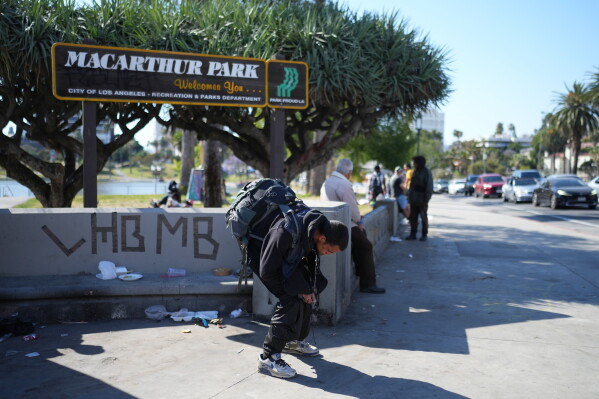
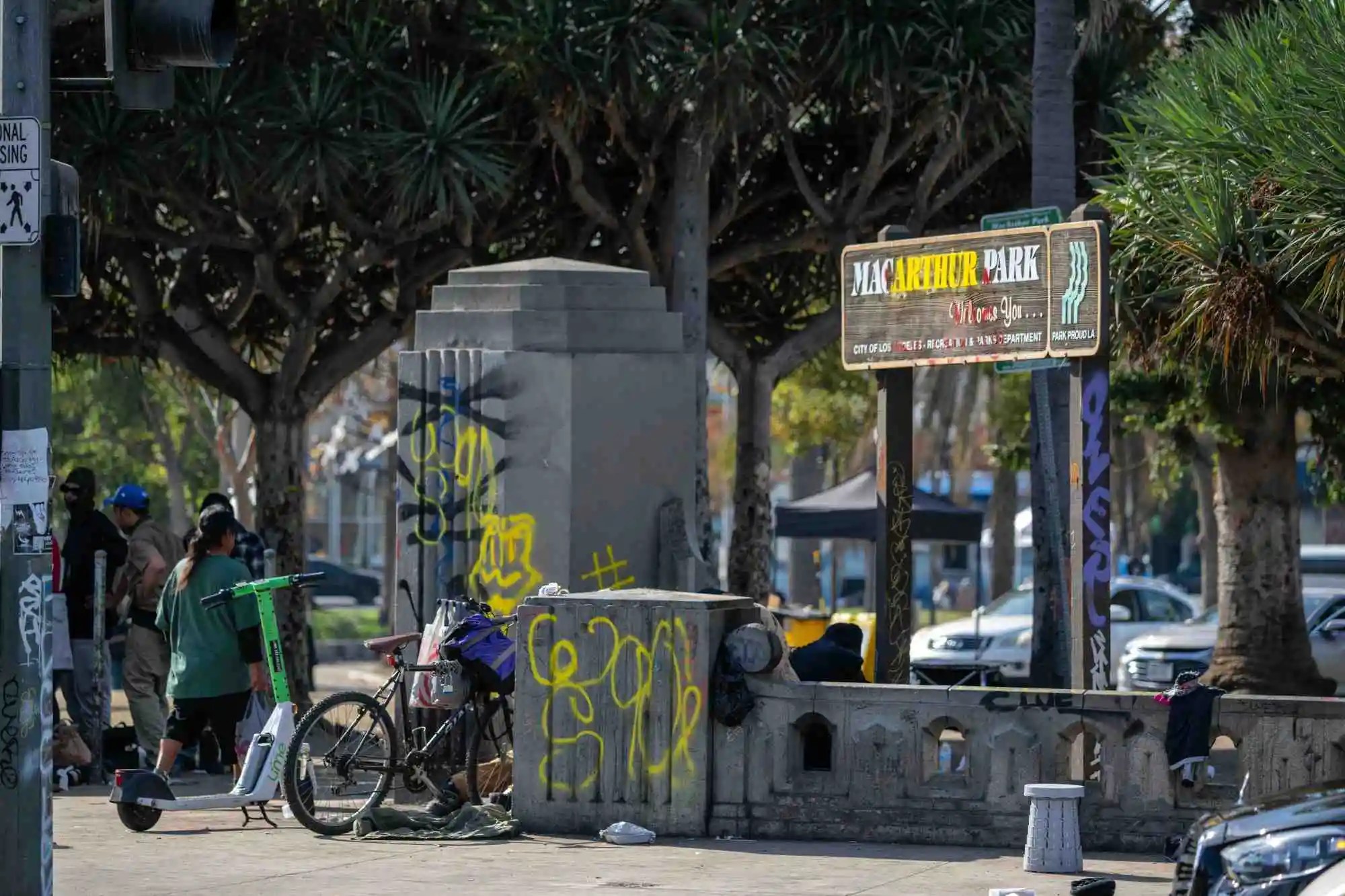
This is your city on socialism
As a result, Hernandez faced five challengers in the June primaries, and won by the slimmest margin of any incumbent in the election. Had her challengers coalesced around a single candidate the outcome may well have been different.
In contrast, the other DSA councilmembers, Hugo Soto-Martinez (CD 13, including Silver Lake, Atwater Village, East Hollywood, and Filipinotown), Raman (CD 4, including Hancock Park, Larchmont, Hollywood, Sherman Oaks), and Ysabel Jurado (CD 14, including Downtown, Eagle Rock, Lincoln Heights, Monterey Park), have proven more moderate in practice. It turns out that when your constituents are looking to you for leadership in the wake of, say, a massive, environmentally catastrophic warehouse fire in the district, you don’t have a lot of time for firebranding.
Which is where DSA rhetoric routinely runs headlong into practical reality. It’s easy to stand on a lectern and call for radical revolution. The reality of governance, particularly at the local level, is more mundane. Much civic administration is downright boring — filling potholes, replacing street signs, passing a budget. Ninety percent of what local electeds do amounts to keeping the lights on. It’s not glamorous. You also have to earn the buy-in of colleagues who have their own ideas (and egos). You have to manage a staff with its own issues and nuances.
Then there’s the inherent tension between ideology and ambition. Democracy has a way of squeezing politicians to the center. Here, Mayor Bass is illustrative. She was a radical in her youth in the 1970s. She made multiple trips to Cuba as a member of the Venceremos Brigade, an overtly pro-communist organization that coordinated trips for young Americans to perform manual labor in the island nation, such as building houses, alongside supporting aspects of the Cuban revolution.
In contrast, she was a thoroughly pedestrian Assemblywoman and Congresswoman. Her most noteworthy accomplishment in 12 years in Washington was a law that strengthens protections for foster children. The bill was signed into law by none other than Donald Trump. It’s laudable, but it’s hardly the stuff of la revolución. She’s proven less effective as Mayor. In the wake of her calamitous performance during the Palisades Fire, at this point she’s in political survival mode (as an aside, it’s fair to ask why she’s even bothering to run again, except for a job and a paycheck).
Bass’s challenger, Raman, won her city council seat in 2020 as a direct result of a DSA-led ground game, beating popular incumbent David Ryu in an upset. In her five and a half years on council she’s distanced herself from the organization, which revoked its endorsement in 2023 after she condemned the Hamas atrocities of October 7 (condemning the worst single slaughter of Jews since the Holocaust is beyond the pale for the DSA — remember that). Even El-Sayed, the group’s current golden child, has attempted to create space.
Indeed, the most notable feature of DSA electeds is incompetence. With a few careless statements Seattle Mayor Wilson triggered an open war with the city’s business community. She has since walked back her positions. It seems that businesses that pay taxes and employ people who also pay taxes are rather important to overall civic health. Who knew? Mamdani has been more aggressive but hasn’t accomplished much. At this point one of his signature policies, free city-owned and operated grocery stores, is a punch line in a bad joke.
For now, the DSA is blowing a lot of smoke without starting any fires. Americans, particularly Angelenos, should breathe a cautious sigh of relief. But make no mistake, the barbarians are at the gate. In November and beyond, L.A. is their best chance to fill enough elected seats that the barricades could buckle. The norms that have checked the Mamdanis, Wilsons, and Ramans could start to give.
So L.A. is the test case. In a worst case scenario, come November (or December, or whenever the Registrar gets around to counting the votes) L.A. could have a socialist mayor, city attorney, city controller, and functional majority on the city council (if they get up to even five seats they’ll be the single largest block, and there are several blow-with-the-wind types in that body that could well fall in line). Will the outcome be the utopia socialists have been promising for 150 years, or a city full of MacArthur Parks? I know where my money is.
 the all aspect report