A silver lining to the budget crisis could be a heaping dose of reality for the City’s delusional transit and transportation officials. Hopefully it’s just the start.
Let’s do some math…..


For the vast majority of Angelenos, useless. Sock photos.
For the fist time in many years, officials and rank and file employees at city and county agencies in L.A. are bracing for budget cuts. Having lived high on the hog for decades thanks to Angelenos’ masochistic tendency to approve all manner of spending, tax, and bond measures to keep those governmental agencies’ lavish budgets afloat, they are about to take a cold plunge into fiscal reality. Overall, some 3,500 jobs are potentially on the chopping block (alas, with few exceptions, the officials responsible for these bloated bureaucracies are safe). Mayor Karen Bass’s proposed budget, released earlier this week, also eliminates the Health Commissions, the Innovation and Performance Commission, and the Climate Emergency Mobilization Commission altogether, the latter two of which smack of wasteful spending boondoggles.
In particular, the Los Angeles Department of Transportation (LADOT) could see its overall budget slashed by as much as 35%. To which we say: It’s about damn time.
Mass transit is a shocking waste of taxpayer dollars
Let’s pull the lens back for a minute and look at mass transit in L.A. County as a whole, of which LADOT is a small part. The Los Angeles County Metropolitan Transportation Department’s (Metro) 2024 budget was $9 billion. For comparison, the combined budgets of city and county fire departments in L.A. County were around $4 billion, and combined police and sheriff’s budgets were around $7.5 billion. The difference is that people rely on fire and police protection every day. In contrast, according to the U.S. Census Bureau, approximately 4.1% of Angelenos commuted via transit at least twice a week in 2023, the last year for which numbers are available, down from 6.5% in 2000. That’s fewer than 400,000 of the county’s 9.7 million residents. Assuming those 400,000 people comprise Metro’s core ridership, the agency spent $22,500 on each of them, or $61 per day. All to transport them an average of less than five miles in each direction, the average transit trip in L.A.
Moreover, despite tens of billions in investment, expansion, and spending, fewer people use transit in L.A. today than in 1980. That means that in a 24 hour period the average Metro vehicle serves just 160 people, or eight people per service hour. That’s just the average system-wide. The vast majority of riders are concentrated on a small handful of routes. The rest are pure waste, serving almost no one.
Naturally, Metro fudges ridership numbers beyond recognition. For example, in an interview with KCRW on Tuesday, Metro CEO Stephanie Wiggins hilariously claimed the system serves one million passengers per day. The reality is that the system gets around 700,000 boardings per day. That still sounds somewhat impressive (though it only represents 7.2% of the County’s population) until you consider that “boardings,” also known as unlinked trips, are a very different metric than “passengers.” A single passenger may board as many as six or eight buses and trains a day — two or three transfers each on their way to their destination and on their way home. According to transit expert Tom Rubin, a friend of the all aspect report, in 2015 the average Metro trip required 2.25 transfers. While that number likely has fallen slightly due to the addition of more direct routes over the ensuing decade, it still puts the average daily ridership number closer to the Census Bureau’s estimate than to the fantasies of Metro officials.
Back to LADOT, which is somehow even worse. It runs two transit systems, DASH and Commuter Express. DASH stands for Downtown Area Short Hop, which was the system’s original purpose, shuttling people around the downtown core. It has since grown to a citywide system with 33 lines that are an average of less than three miles. Think of DASH as a system of neighborhood jitneys.
The agency claims that the two systems served a combined 13.5 million boardings in 2023, the most recent year for which figures are available, or 36,833 per day. Assuming a conservative two boardings per passenger, that’s 18,417 passengers per day, or 0.48% of the city’s population. The two systems’ combined budget was $181.6 million in 2023. That’s $497,534 per day, which works out to $27 per passenger ride. Again, the average DASH route is less than three miles, and like Metro the vast majority of its paltry ridership is concentrated on a small number of those routes. The system’s budget deserves to be cut, and should have been a long time ago. Figure out where those 18,417 are concentrated, and eliminate the other routes.
Of course, this raises a conundrum: How can the city serve the handful of residents who would be negatively affected by those eliminations? The grandmother in Pico Union who relies on the DASH bus in her neighborhood, even though she’s virtually the only one? For a fraction of the cost of a full service bus transit system the city could invest in point-to-point, on demand shuttles, along the lines of airport shared van services like Super Shuttle. They would be more efficient for riders (not to mention safer) and more cost effective for taxpayers. Alas, transit officials are committed to those bus systems. You’ll have to pry the ENC E-Z Rider II Maxes out of their cold, dead hands.

A typical LADOT DASH bus interior at commute time.
There is waste throughout the city’s and county’s mass transit system. The Metro K light rail line connects Santa Monica, Westwood, Palms, Culver City, Jefferson, Crenshaw, Expo Park, and Downtown, some of the most densely populated neighborhoods in the City of L.A. On paper it should be hugely popular, yet it has by far the lowest ridership of all Metro light rail lines, with just 3,118 riders per day, or 130 people per hour. The K Line operates trains of two to three Kinkisharyo P3010 rail cars, each with a capacity of 180 riders. The system runs an average of two cars every 15 minutes in both directions between 4:00am and midnight, for a total of 144 trips per day. That’s enough for up up to 51,840 passenger trips, meaning the system — which cost $2.1 billion to build and $120 million annually to operate, carries just 6% of its capacity. Based on operating costs alone, that works out to $105 per passenger trip, or $210 for a round trip that is a maximum of 22 miles. For comparison, you can fly round trip from LAX to JFK for as little as $207 (granted, you’ll be flying Frontier, but the point stands). Viewed another way, the average cost per mile per seat of a LAX to JFK flight is $0.12. The K Line costs $9.54 per seat per mile.
They built it, and no one came
Over the last decade in particular, the endless flow of taxpayer money has enabled LADOT and Metro to pursue a strategic plan that amounts to “build it, and they will come.” The agencies have poured money into dedicated bus lanes and, in the case of Metro, bus rapid transit (BRT) lanes that clog up traffic for everyone else, costing commuters time and money while increasing emissions. Metro has spent billions more on light rail no one rides, including the laughable construction of a subway from downtown to Westwood, the much ballyhooed Purple Line that’s caused endless traffic snarls on Wilshire Boulevard for more than five years. But hey, at least when it’s done UCLA students will be able to get to Union Station in just over half an hour. That’s progress, L.A. transit style.
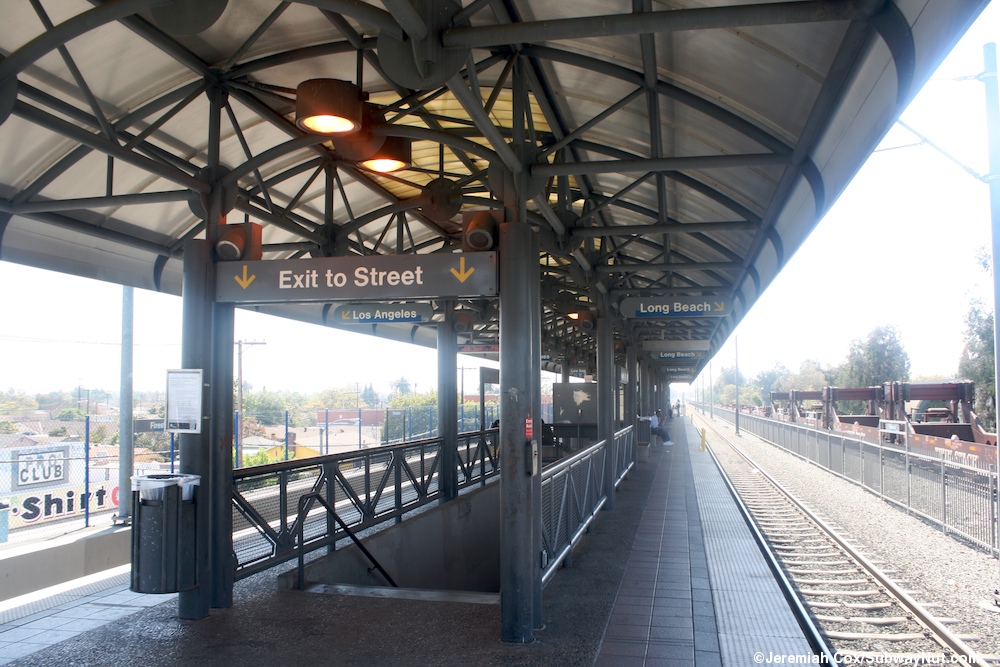

They built it, and no one came. Stock photos
In short, LADOT and Metro have wasted countless billions of dollars on what amounts to a failed theory that they could somehow transform a city and county that are among the most car-dependent on Earth into transit Utopias. It was a dandy theory. The only problem was reality. The saying among athletes is that Father Time is undefeated. When it comes to transportation and urban planning, geography is the all time champion. It defies physical reality to expect 9.7 million people in a sprawling county of 4,097 square miles of suburbs, coastal hamlets, mountain communities, desert enclaves, semi-urban single family neighborhoods, and multiple dense urban cores to swap their Buicks for buses, their Lexuses (Lexi?) for light rail, their Bimmers for bicycles, their Toyotas for their own two feet. It was never going to happen. It never will. LADOT and Metro represent a triumph of blind ideology over actual lived experience. Cutting LADOT’s budget is a great start. In a just world it will force the agency to focus on services people actually use, and to think creatively about how it can reform to provide new services, like those shared point-to-point shuttles.

Wasn’t it pretty to think so? Image generated by Gemini AI.
A year from now, when the budget cuts have taken effect and LADOT has made the resultant service cuts, it’s a safe bet virtually no on in L.A. will have noticed. There is one concern, however. Government bureaucrats are notorious for taking out the consequences of their own inefficiency and incompetence on average folks. It’s possible that LADOT will choose to make cuts to its few heavily used routes, to make a point. Rather than trimming some of the copious fat officials may go for lean muscle. Then they’ll turn around and say, “See? We told you how essential we are!” Keep your eyes peeled for such headlines in the dutiful Los Angeles Times, and do not be fooled.
Good luck with those “car-free Olympics”
Perhaps the agency’s most quixotic, and doomed, transit initiative was LADOT’s and Metro’s promise, supported by Mayors Eric Garcetti and Karen Bass, that the 2028 Olympics will be “car free.” Despite the fact that the Games will be scattered literally to every corner of the City and County of Los Angeles in some 40 different venues, officials promise that visitors will be able to visit all of them via mass transit. The pledge was unrealistic, bordering on delusional, from the start. The plan, such as it is, was for LADOT and Metro to “borrow” (read: rent) 2,700 additional buses from transit agencies across the country. Because, apparently, driving thousands of diesel and natural gas buses across the country driving them around L.A. for three weeks, and then driving them back, counts as sustainable. Other cities likely will send their older buses, with their higher emissions and maintenance requirements.
Because of course millions of visitors will eschew renting cars to visit the Games and other attractions around L.A., choosing instead to spend hours inside sweltering buses in mid summer. Because of course. The $3.3 billion plan is already on the verge of collapse, with only 5% of necessary infrastructure completed as of the end of 2024. Incidentally, the cost of renting those buses, transporting them to L.A., operating them, and maintaining them, will be around $2.7 billion. For comparison, the entire Paris Olympic Games cost $9.7 billion.
Meantime, Metro cannot even keep its own drivers safe. Violent attacks, primarily by homeless vagrants, have become so common that last year the agency spent millions installing clear protective barriers around bus drivers’ seats. In other words, rather than do the hard work of securing its system, particularly by bringing the L.A. County Sheriff’s Department back into the fold, the agency decided to protect its employees, but not its riders. Welcome aboard, folks!
Cutting funding for bike lanes to nowhere
The inefficiency and frivolity of LADOT’s and Metro’s transit systems are exceeded only by the vanishingly small but deafening loud (and deeply funded) cohort of “bicycle activists” who have spent the last decade lobbying the city and county to expand its network of “bicycle infrastructure.” As a result of their activism and spending, LADOT in particular has installed bicycle lanes, road diets, and other anti-car obstacles, collectively known as “Complete Streets” along hundreds of miles of streets and in thousands of intersections. If people won’t voluntarily get on the bus, the agency will make driving increasingly miserable until they’re forced to.
The activists deserve credit for their propaganda efforts. During the 2023 primary elections, they spent more than $3 million — a good portion of it from a New York based billionaire hedge fund manager — on a campaign called “Healthy Streets LA,” or Measure HLA. It was a master class in propaganda, because who in their right mind opposes healthy streets? Of course, the reality is different. HLA requires StreetsLA, formerly known as Streets Services, to install bike lanes, dedicated bus lanes, or other “Complete Streets” features anytime the agency repaves or otherwise remediates any section of street longer than 880 feet, or roughly a city block.
If you think that sounds like a recipe for confusion, chaos, and danger, that’s because it is. If implemented, street design would change radically from block to block — a bike lane for a block, then no bike lane, then a bus lane, then a bike lane and a bus lane, then no bike or bus lanes. And, of course, bollards everywhere.
The richly funded activists — overwhelmingly young, college educated (natch) white males — argued that HLA was necessary due to an “epidemic” of traffic accidents, severe injuries, and deaths. Again, it was propaganda. In reality, bike lanes and Complete Streets are among the primary causes of accidents, injuries, and fatalities, because they are so confusing and distracting. Indeed, after a steady four decade decline, severe injury and fatal traffic accidents spiked immediately after L.A. rolled out a citywide anti-car policy known euphemistically as Vision Zero (without going into detail, Vision Zero is essentially Complete Streets on steroids). The more confusing bicycle lanes, lane striping, signage, road diets, and bollards went in, the more people died. Emergency vehicles routinely get bogged down in the resultant traffic, adding precious minutes to response times and costing additional lives.
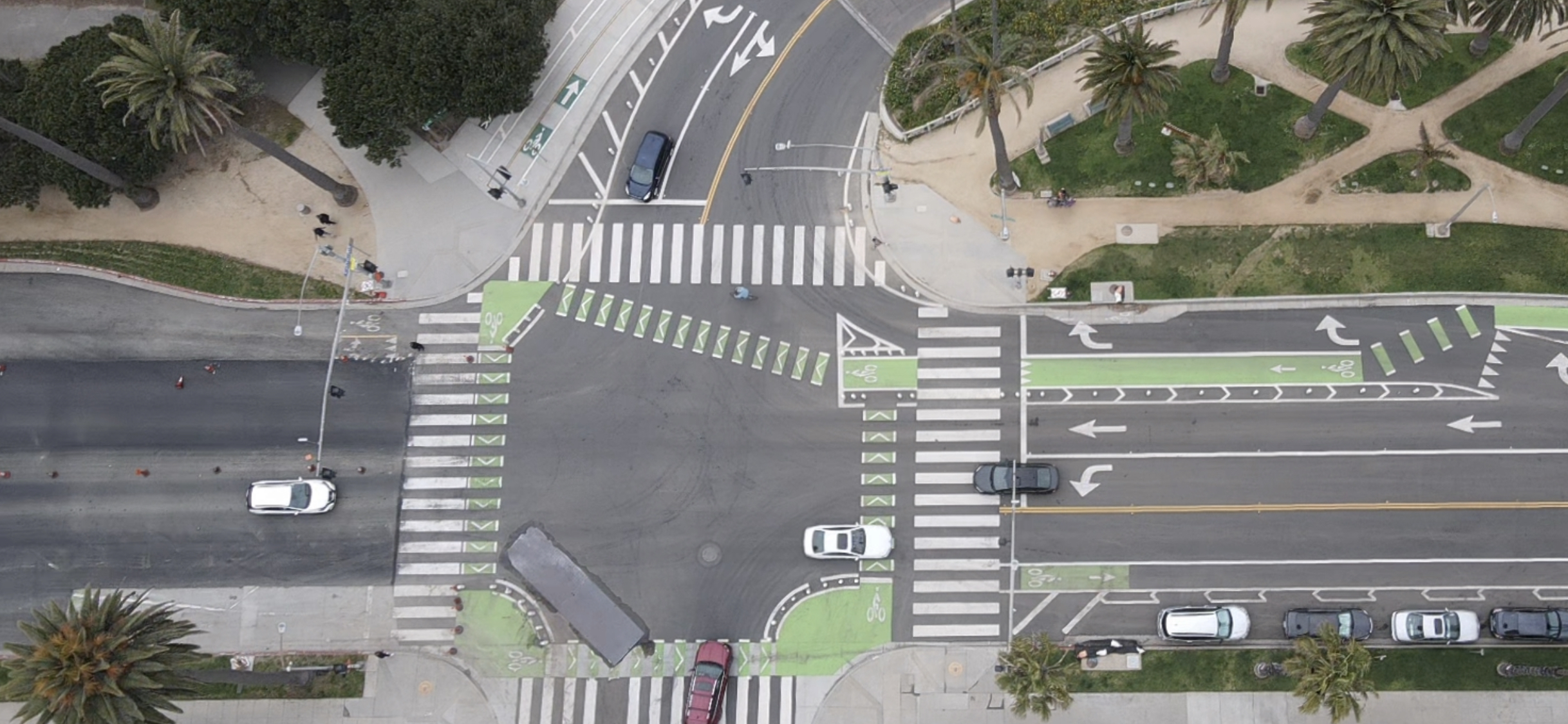
A typical “Complete Streets” intersection, inspired by the noted transportation engineer M.C. Escher. Note the top left, where the bicycle lane and pedestrian crosswalk literally crash into each other. Safety! Photo by Christopher LeGras.
So it’s gratifying to know that StreetsLA will face budget cuts that will make it all but impossible to implement HLA, much less at the scale the activists desire. Lives will be saved as the city is forced to roll back its misguided anti-car initiatives.
These are the silver linings to the coming budget cuts. LADOT will finally, hopefully, be forced to live within its means and to provide transit service actual human beings actually need. With less money for misguided initiatives like HLA, perhaps the agency will also start exploring implementing bicycle lanes people will actually use — not on major thoroughfares but on quiet, tree shaded side streets.
Then again, we’re not holding our breath.
 the all aspect report