A solid if unremarkable song has become the latest focus of jeremiads from the Left and Right, because the twittering class won’t let Americans have nice things these days

So a fellow writes a song about the plight of the country’s poor and working poor, giving voice in his way to folks who’ve spent the better part of half a century getting pummeled by outsourcing, globalization, digitization, and financialization. There was a time, not so long ago, when “Rich Men North of Richmond” would have been unremarkable. From Woody Guthrie to Public Enemy the struggles of the underclass were central to American popular music in the Twentieth Century. As recently as the late 90s and early 2000s, when Gen X was having its grunge moment, artists penned anthems to the underclasses (granted, some of those efforts are rather less successful in retrospect – you probably don’t want to re-listen to Pearl Jam’s “Elderly Woman Behind the Counter in a Small Town,” for example).
Alas, in our current Swiftian age the poor and working classes get short shrift. Pop stars are more likely to sing about Bulgari bling and Bugattis than border towns and broken bank accounts. Outside country music you won’t hear much about the travails of so many blue collar Americans, and even in that genre you’ll hear more about beer, pickup trucks, and cutoff shorts than the local factory shutting down. All of which makes Anthony’s “Rich Men North of Richmond” a throwback, a protest song in the old tradition. It went viral and hit the top of the charts. Not bad for a guy who never before had even a modest hit.
And because Americans can’t have nice things these days, it took approximately twenty-five seconds to become politicized.
Republican politicians seized on the song, and Anthony himself, as one of their own. The thoroughly noxious Marjorie Taylor Greene, who has the artistic sensibilities of a drunk fruit fly, declared it was the “new anthem of forgotten Americans.” The party even played the song before their first presidential primary debate last week. Democrats, particularly the ones in big coastal cities who know as much about places like Anthony’s hometown of Farmville, Virginia as they do about bass fishing, wailed that the song is … wait for it … right-wing and racist. It’s a safe bet many of them didn’t bother listening to it.
Sigh. Just. Freaking. Sigh.
Out here in the American Political Wilderness, we listened to the song without much reaction. It’s fine. It’s not groundbreaking. It treads a familiar path, albeit one that’s overgrown with weeds these days. Anthony has a strong voice, a mid-range tenor with a convincing Mississippi twang and nice vocal breaks. Dude’s got some talent. And it’s easy to imagine his lyrics coming out of the mouths of the people he’s singing about.
I’ve been sellin’ my soul, workin’ all day
Overtime hours for bullshit pay
So I can sit out here and waste my life away
Drag back home and drown my troubles away
It’s a damn shame what the world’s gotten to
For people like me and people like you
Wish I could just wake up and it not be true
But it is, oh, it is
Again, solid. Unremarkable, but solid. In a sane world it would hover in the top half of the country and Americana charts, then fade away. I’ve listened to a few of his other tracks, and my sense is he’s going to struggle to put together a complete album that sustains the energy of “Rich Men” for 50 or 60 minutes. Despite his strong voice he has a narrow vocal range, and after three or four songs his compositions and lyrics start to feel redundant, if not reductive. He repeats a lot of the same ideas and similar phrases.
Of course, we don’t live in a sane world. We live in a world where an obscure protest song by an obscure Virginia singer-songwriter becomes the subject of scores of essays, blog posts (hello!), and cable news segments, along with who knows how many thousands of lines of social media spleen venting. We live in a world where that obscure song is endlessly dissected, word by word, by journalists and writers and pundits who ought to be spending their time scrutinizing, say, the creeping state takeover of local democracy that’s happening in blue and red states alike.
Like so much modern political – oh, let’s call it “discourse” – there is something deeply unserious about all the sturm und drang. Then again it’s a lot easier to get exercised over a three and a half minute ballad than it is to delve into the minutiae of profoundly consequential yet complicated state legislation. So here we are. Oliver himself has distanced himself from the political frenzy his song unleashed, Tweeting (X-ing?) that “I. Don’t. Support. Either. Side” and referring to himself as “just some idiot and his guitar” (we’re starting to like this guy, out here in the Wilderness). He’s said the song is a rebuke to both parties, and it’s not hard to listen to it as such. MAGA red meat it is not.
The unseriousness attains a degree of irony when you realize that much of what everyone is arguing about is Anthony’s “authenticity.” It reminds me of arguments my friends and I used to have back in middle school over whether this or that band had “sold out.” Such is the state of political discourse these days. No wonder the Political City dwellers have us looking down the barrel of Biden v. Trump redux.
Anthony’s song isn’t racist, but it is wrong on an important point
It seems the particularly vexing lyrics are from the song’s bridge: “And the obese milkin’ welfare / Well, God, if you’re five-foot-three and you’re three-hundred pounds / Taxes ought not to pay for your bags of Fudge Rounds.” Democrats hear the proverbial racist dog whistle, an allusion to Ronald Reagan’s infamous invocation of black “welfare queens” to justify cutting federal social services. They accuse him of “punching down” on the poor, which is ironic given that he wrote and recorded the song in a trailer in the Virginia backwoods. Republicans hear … I don’t know, something about smaller government, maybe?
Ladies and gentlemen, they have politicized snack foods.
Again, the kerfuffle is deeply ironic. That’s because Anthony isn’t racist or punching down, he’s wrong: Poor people in this country become obese not because they’re “milkin’ welfare” but because the sustenance to which they have access is almost guaranteed to make them so. Ingredients are processed and refined to the point that they barely resemble food. To get any actual nutrition people have to consume huge amounts of empty calories. The United States is one of the only countries in history with fat poor people. Fat white people in trailer parks, fat black people in neglected urban areas, fat native Americans on hopelessly destitute reservations. Migrants come to this country and become fat on their new American diets.
According to the CDC 41.7% of adult Americans are obese and another 30% are overweight. In fact, due to food insecurity and lack of access to quality food poor people are more likely to be obese, whether or not they’re on public assistance.
If you live in an inner city or rural food desert and do most of your shopping at 7-11 and Family Dollar, if going out to dinner means Waffle House, Popeye’s, or Chick-Fil-A, it’s a minor miracle if you don’t become overweight. If you were raised in an environment in which fruit roll-ups constituted “healthy options,” if you attended a public school that served hot dogs, spaghetti and meatballs, and white bread sandwiches stuffed with processed meats at lunch and featured soft drink vending machines in the hallways, your waistline barely stood a chance.
In this context Anthony’s anger is misguided. And his defense of the lyrics feels disingenuous. He wrote on Instagram that “The lyrics contrast that some are left without any, and others are only left with the option of living on junk food.” If that’s really what he was getting at, there was a more eloquent way to express it. In particular, the five-foot-three and three hundred pounds line is the only time in the song he directs the “you” at an identifiable kind of person. He does sound legitimately mad at people he thinks somehow are taking advantage of the system.
That said, there is such a thing as inner-class resentment. There is a vein of disdain among the working poor for those who they perceive as having “given up” and started accepting public assistance. It’s the kind of nuance that gets drowned the churning surface froth of political rage: In some cases the resentment is justified. There is such a thing as fat and lazy. In other cases the vitriol is little more than projection. To the extent his lyrics universalize the former attitude, some criticism is warranted.
There’s a better version of “Rich Men” out there right now
Another song of the moment serves as a better homage to the working poor: Tracy Chapman’s classic “Fast Car,” which got a second life this summer thanks to a cover by country banger Luke Combs. It’s made even more potent by the fact that it’s a cover by a straight white man of a composition by a queer black woman. Out here in the Wilderness we call that America. Down in the Political City they call it appropriation on the left, and race baiting on the right.
See? We can’t have nice things. For God’s sake they even weaponize puppies down there.
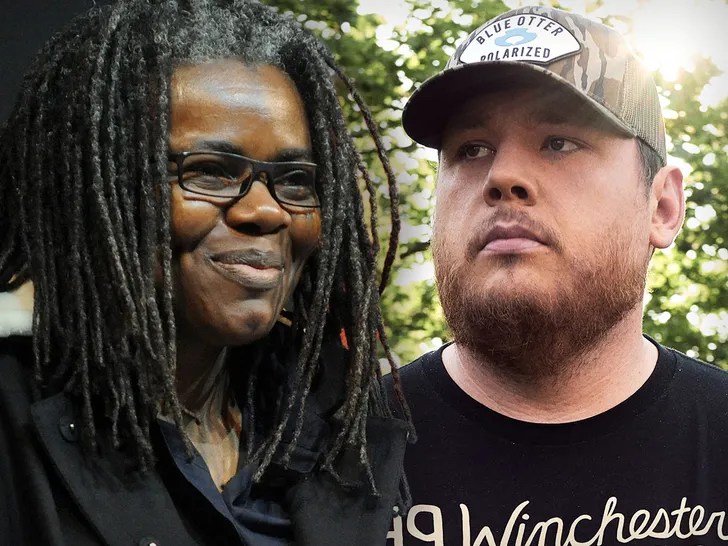
This other kerfuffle was started by a Washington Post columnist who bemoaned, “Although many are thrilled to see ‘Fast Car’ back in the spotlight and a new generation discovering Chapman’s work, it’s clouded by the fact that, as a Black queer woman, Chapman, 59, would have almost zero chance of that achievement herself in country music.”
This is insane. Chapman is not a country artist, and has never written a country song. It’s like lamenting that Metallica never made it to the AOR charts until Pat Boone covered “Enter Sandman” complete with a horn section and backup singers (it’s one of the most bonkers covers ever). Thanks to Combs’s version of one of the greatest songs in American popular music, new generations and millions of people are discovering Chapman who otherwise wouldn’t have. And the reclusive Chapman, who hasn’t released an album in 15 years and has made a single appearance in that time, is going to get a nice infusion into her bank account (full disclosure and fun fact: I represented Chapman in property dispute in San Francisco back in 2006). Everybody wins – which is why the twittering class cannot stand for it.
So Oliver Anthony and Tracy Chapman are having their moments, both thanks to songs that evoke the struggles of the country’s poor and working poor. It would do the Political City dwellers on both sides well to look past the politics (if only!) and ponder why.
Meanwhile, out here in the Wilderness, we’ll just enjoy the tunes and be grateful to live in a country where they’re possible in the first place.
As always, we’ll keep a cold one in the fridge for you.
 the all aspect report