Twenty-five or so years ago, “Merry Christmas” began to give way to “Happy Holidays.” Personally, I was okay with it. I ignored the Bill O’Reillys of the world who hollered about a “war on Christmas.” I’d always celebrated both Christmas and Hanukkah. Growing up in West L.A., many of my closest friends from childhood are Jewish. Heck, my godparents were Jewish (my family went to an Episcopal church that followed the traditions loosely even by the standards of that denomination). In elementary school, our holiday pageants featured Christmas songs and Hanukkah songs, including a medley of “Christmas is Coming” and “Hanukkah, Oh, Hanukkah,” which fit together surprisingly well. Menorahs and dreidels in public spaces were as integral to the season as Christmas trees and Santa Claus. In fact, until I was seven or eight years old I actually thought my family was part Jewish. I was shocked, and saddened, when I learned we weren’t.
In short, saying “Happy Holidays” fit naturally with those experiences. It didn’t feel like some sort of attack on Christmas, it felt like widening the embrace of that time of year.
In the ensuing years, though, other aspects of the holiday season changed. It was subtle at first. Big chain stores started toning down their Christmas decor. Grocery stores, retail franchises, even fast food chains seemed to put less effort into decorating each year. By the late 2010s they were reduced to half-hearted strings of white lights and — maybe — a small Christmas tree that evoked the poor sapling from “A Charlie Brown Christmas.”
Likewise, when we were growing up, the TV networks would broadcast classics like “Charlie Brown,” “Frosty the Snowman,” “Rudolph the Red-Nosed Reindeer,” “How the Grinch Stole Christmas!” and other classics multiple times in the weeks leading up to the big day. Over on basic cable, “A Christmas Story,” “National Lampoon’s Christmas Vacation,” and, of course, “It’s A Wonderful Life” would air practically nightly. As long as two decades ago, well before streaming swept away what was left of “appointment TV,” the networks had throttled way back.
Of all the changes, the most dramatic was the virtual elimination of Christmas from public spaces. For example, Wilshire Boulevard through Beverly Hills used to be positively festooned with lights, giant snowflakes, other decorations and trees, culminating with a massive Santa’s sleigh and reindeer — complete with Rudolph leading the way — soaring over the intersection of Wilshire and Beverly Drive. Santa still makes his annual appearance these days, but the rest of the street is nearly bereft of decor, save for some white lights. Driving around much of West L.A. in December these days, you’d be forgiven if you forgot Christmas was coming at all.
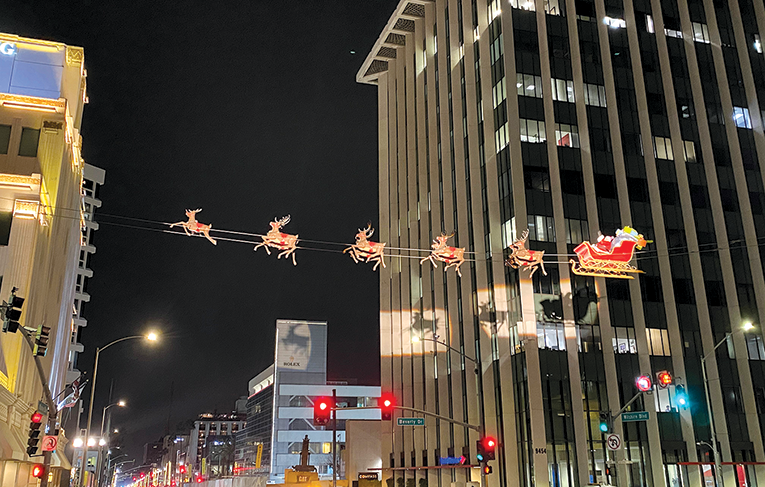
Santa is pretty lonely these days….
Which brings us to Santa Monica. Since at least the 1950s, the city allowed local residents to erect a series of 14 Christmas creches along Palisades Park that told the Christmas story. They were large, imaginative works of art, starting with the Three Wise Men and culminating with a manger scene. The tradition continued until 2011, when a small group of atheists flooded the city with their own permit applications for the display sites. They succeeded in creating such a bureaucratic mess that the city threw up its hands and established a blanket prohibition on “unattended displays” on city property. The killjoys won, and the world became a little sadder.
The early 2000s saw a spate of such incidents around the country, as atheist activists sought to eliminate any hint of Christmas from the public square (they generally left Hanukkah displays alone). This became known as the “heckler’s veto,” in which the activists prevailed in city after city. Santa Monica was far from the only scalp they collected, it was just one of the more noteworthy.
The first year an atheist obtained permits for sites that had traditionally been used for the nativity scenes, he put up a chain link fence and hung a sign declaring, “Religions are all alike, founded upon fables and mythologies.” This quote has long been spuriously attributed to Thomas Jefferson, who never uttered it (in its decision upholding the city’s termination of the nativity tradition the Ninth Circuit Court of Appeals, with its typical depthless ignorance, attributed the quote to the Founder). Another site featured a sign with pictures of Poseidon, Jesus, Santa and Satan, with the caption “What Myths Do You See?”
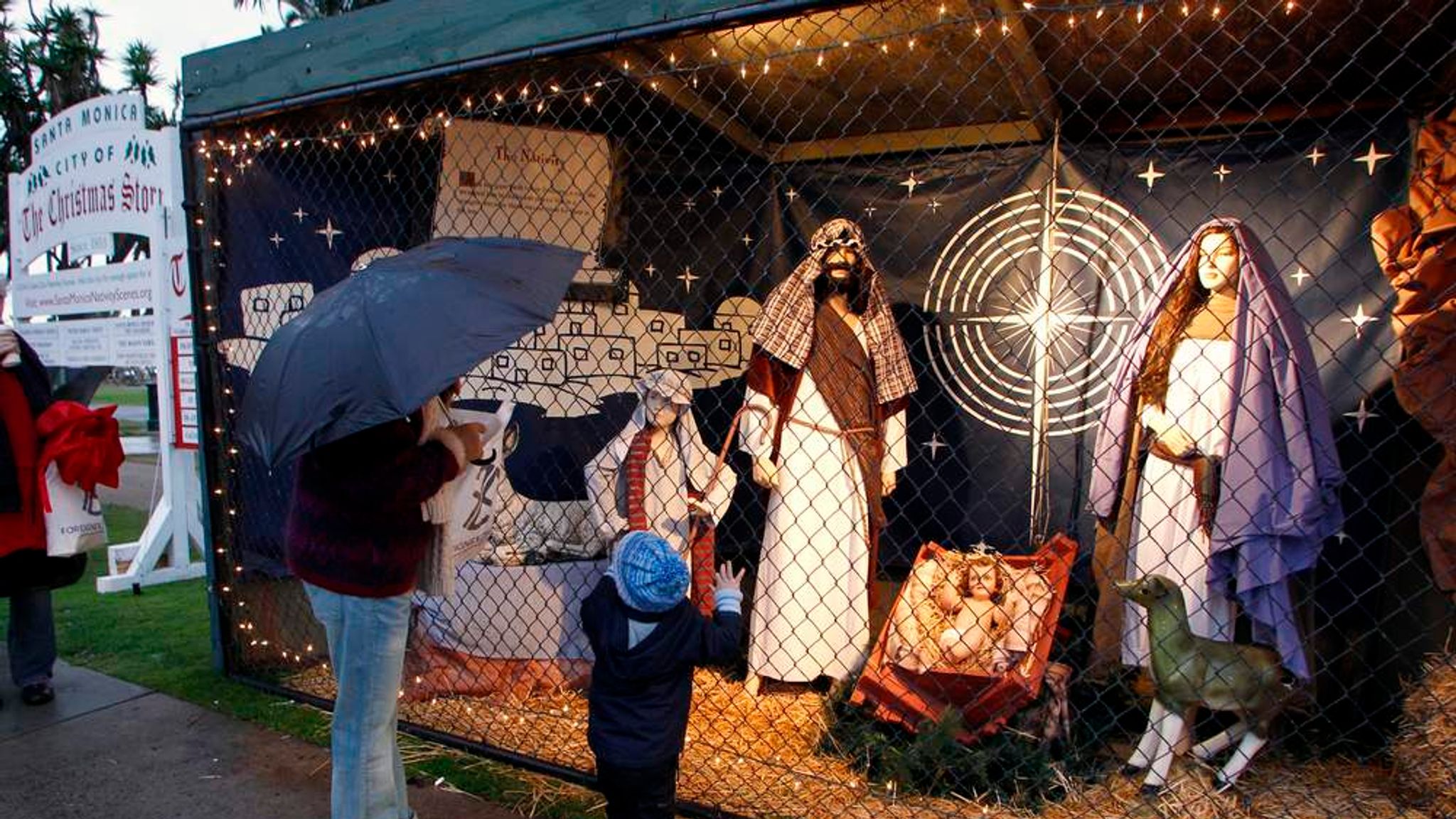

Joyousness, and a jerk.
I find it impossible to imagine the sort of mindset that causes one to experience blind rage at the mere sight of a manger scene, much less a degree of rage that causes one to spend years of their life fighting to eliminate it and to go to the effort and expense of putting up signs in public mocking the faith of two and a half billion human beings. That’s a special kind of hate, and it prevailed in Santa Monica.
And then there’s the incandescent hypocrisy. Atheism is every bit as much a faith as any organized religion. The lack of God is no more provable than God’s existence. If you can find a clearer example of fanaticism and violations of the First Amendment than a tiny minority of zealots using bureaucratic mechanisms to eliminate all vestiges in public spaces of expressions of any faiths with which they disagree, in the process imposing their own, I’m all ears. If you took a poll, I’d wager that 90% of Santa Monicans would support restoring the nativity scenes — including most atheists.
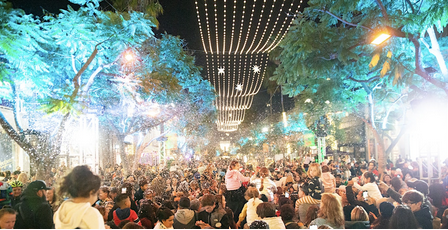
Which brings us to the “Holiday Tree.” The picture at the top of this post is from the official city email announcing the lighting ceremony. The good news is that it at least resembles a Christmas tree (albeit without the star on top — they got rid of that a few years ago, probably because an atheist activist complained it hurt his feelings). During the lighting ceremony there will be carols, and Santa will make an appearance.
And that’s about it. The holiday lighting palette, a sort of vomitous green-blue, appears to have been selected intentionally to avoid evoking so much as a hint of Christmas or Hanukkah. You’ll see nary a hint of green and red of the former or the blue and white of the latter. Similarly, the decorations on the “Holiday Tree” are shades of purple, gold and that same nauseating green-blue. The color will be on display throughout downtown.
Even before the woke crowd took over City Council last year — give them credit, they know how to organize and, particularly, how to harvest ballots — Santa Monica was increasingly in thrall to the sorts of self-appointed moral scolds who increasingly dominate California politics in general. Gone are the wonderful summer Pier Concerts, gone are the jazz concerts at City Hall, gone is the once thriving scene at the Third Street Promenade. The Broad Stage is a shadow of its former self. But hey, you can still get a $12 glass of beer on Main Street or a $23 hamburger on Montana.
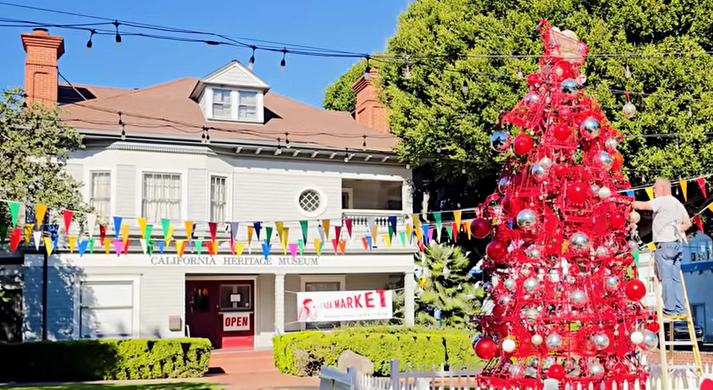
And then there’s this hot mess — a “holiday tree” made out of painted shopping carts in front of the California Heritage Museum in Santa Monica. Because, apparently, homelessness.
In short, the elimination of the nativity scenes in Palisades Park, and the elimination of so much public celebration of Christmas and Hanukkah, were harbingers of things to come. This is what happens when woke takes over: A war on Christmas, a war on tradition, pretty soon you have a war on social cohesion, a war on the very way Americans live, and, ultimately, a war on joy itself. Santa Monica is emblematic of the masochism and self-loathing at the heart of modern woke progressivism. You won’t see any nativity scenes these days, but you’ll see plenty of openly intoxicated homeless people. One gets the distinct sense that that’s how they want things to be. They won’t rest until the rest of us are as miserable as they are. The joy of Christmas makes them seethe. They make the Grinch look like Rudolph.
And they’re winning.
I’m not Christian. I haven’t stepped foot in a church in many years. And while I fall into the category of people who tend to get a bit glum during the holidays, I’m grateful for the traditions that the Judeo-Christian tradition bestowed on our society. Their diminution is bad for everyone, of all faiths. I’m grateful for Christmas, Hanukkah, Thanksgiving and Easter. I’m grateful that the holidays cause this frenetic world to slow down a bit at the end of the year.
In what should be the most wonderful time of the year, Santa Monica stands as a warning to the rest of the country.
 the all aspect report