What is “misinformation,” exactly?

The monumental miniseries Chernobyl portrayed a local Soviet party boss named Zharkov ordering the city of Pripyat locked down to prevent the spread of “misinformation” after the 1986 nuclear explosion. Screen capture from hbo.com.

Over the last decade Americans have been bombarded with stories about misinformation, disinformation, and “fake news.” Much of the coverage has rightly focused on Donald Trump. However, here in California, our state government has become one of the biggest purveyors of demonstrably false narratives, particularly when it comes to homelessness, crime, and sustainability.

I don’t know if there’s any cosmic significance to the fact that the Chernobyl miniseries, which in my humble estimation is the greatest in television history, premiered on my birthday in 2019. Probably not. But the show left an indelible mark on my perception of not just the 1986 nuclear reactor meltdown in what was then Soviet Ukraine, but also on my perception of modern California politics. That’s because there are disconcerting parallels between the show’s portrayal of the Soviet political class’s reactions to the disaster – breathtaking pettiness, catastrophical myopia, incomprehensible dishonesty, and hysterical paranoia – and the responses of Golden State’s political class to the many crises afflicting the world’s fifth largest economy.

Before delving in to the specifics, it’s important to note that the miniseries is not a documentary, or even a docudrama. It is a significantly fictionalized account of historic events. While it hews to the basic facts of the disaster, much of its narrative power comes from the writers’ decisions to emphasize certain aspects of the story while embellishing others for dramatic impact. An illustrative example is how the series portrays alcohol consumption in the Soviet Union. Alcoholism was indeed a major public health and even economic concern throughout the USSR’s existence, accounting for as much as a 10% loss in GDP. However, the Chernobyl disaster occurred in the midst of a major, and fairly successful, governmental push to reduce the nation’s fondness for vodka. In the show, seemingly everyone in the country is constantly imbibing, even during formal meetings in front of colleagues. As a factual matter this is inaccurate, even unfair. However, the show uses rampant casual drinking in the face of a national emergency symbolically to reflect the casual incompetence and negligence that characterized the late Soviet Union’s political and bureaucratic classes. It’s effective as a storytelling device.

The fact that Chernobyl features many such embellishments makes the comparison to current California politics that much more poignant: The Golden State doesn’t need any such license.

The tyranny of bureaucracy

In the first episode of Chernobyl, hours after the explosion in the plant’s Reactor #4 a man called Zharkov, the boss of the Pripyat governing council, the ispolkom, convenes an emergency meeting of the council and the plant’s management. The meeting immediately devolves into passive aggressive accusations and recriminations as the men in the room toss blame for the disaster back and forth like a chunk of radioactive graphite. Zhukav, who is in his 80s, taps his cane on the floor loudly five times, silencing the room. He delivers a brief soliloquy about the plant’s history, reminding them that while the plant is known as Chernobyl after the city in which it is located, its formal name is the Vladimir I. Lenin Nuclear Power Plant. “And how proud he would be of all of you tonight” for their heroic actions, he intones.

In a moment that demands scientific exactitude and strict organizational accountability, Zharkov mixes this kind of flattery with a quasi religious homily to the Soviet state. His eyes twinkling with memories of the Revolution, the old man reminds the others that their “faith in Soviet socialism will always be rewarded.” Literally standing a few hundred meters from a nuclear inferno he admonishes, “the State tells us that the situation is not dangerous. Have faith.” As for the fears of the residents of Pripyat, which was built as a model city for plant employees and their families, he says “it is my experience that when the people ask questions that are not in their own best interest, they should simply be told to keep their minds on their labor, and to leave matters of the State to the State.”

Then, in one of the most chilling moments of the series, his voice drops an octave and he pivots. In order to protect the State, “We seal off the city. No one leaves. And cut the phone lines. Contain the spread of misinformation. That is how you keep the people from undermining the fruits of their own labor.”

Of course, by “misinformation” Zharkov means “the truth.” The people’s “best interest” is to believe the official lies about the disaster and its causes and consequences. Though Zharkov’s speech takes up barely a minute of run time, it sets the stage for all that is to come. Chenobyl is a masterpiece in many ways, particularly its portrayal of how human beings function when they are trapped in a massive, labyrinthine, unaccountable bureaucracy in a time of crisis. The characters inhabit a world in which that bureaucracy dictates every aspect of their lives, up to and including the meanings of words themselves. Truth becomes misinformation and rational inquiry is suspect, even dangerous. The bureaucracy decides what is in individuals’ best interests.

There’s no record of a speech like the fictional Zharkov’s during the nuclear crisis. Thanks to Soviet secrecy, which Russian President Vladimir Putin is all too eager to perpetuate, to this day the historical record of the disaster remains incomplete, particularly when it comes to on-the-ground decisions in the days and weeks immediately after the explosion. Nevertheless, words like his were assuredly heard up and down the Soviet chain of command and within the country’s ossified political class throughout the crisis. Like all Socialist governments, from North Korea to Venezuela, Soviet Socialism was always more a dogmatic orthodoxy than a coherent governing philosophy.

Homelessness is California’s Chernobyl

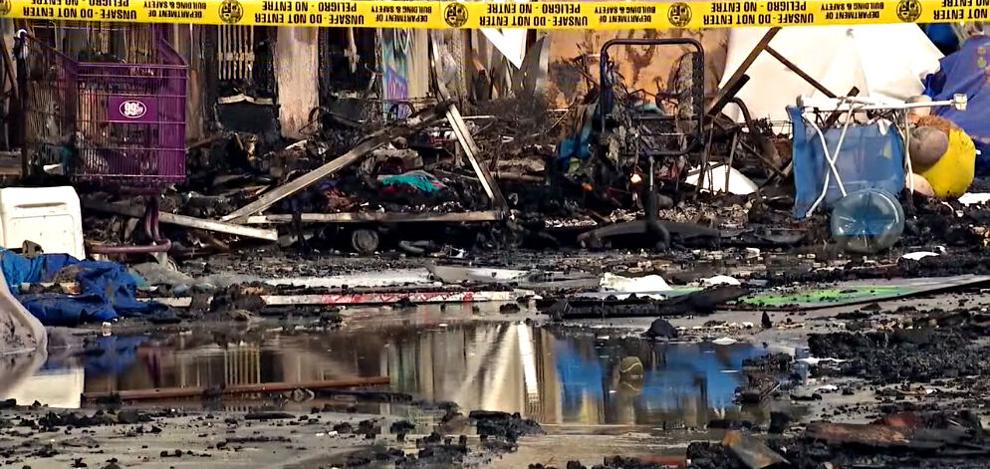
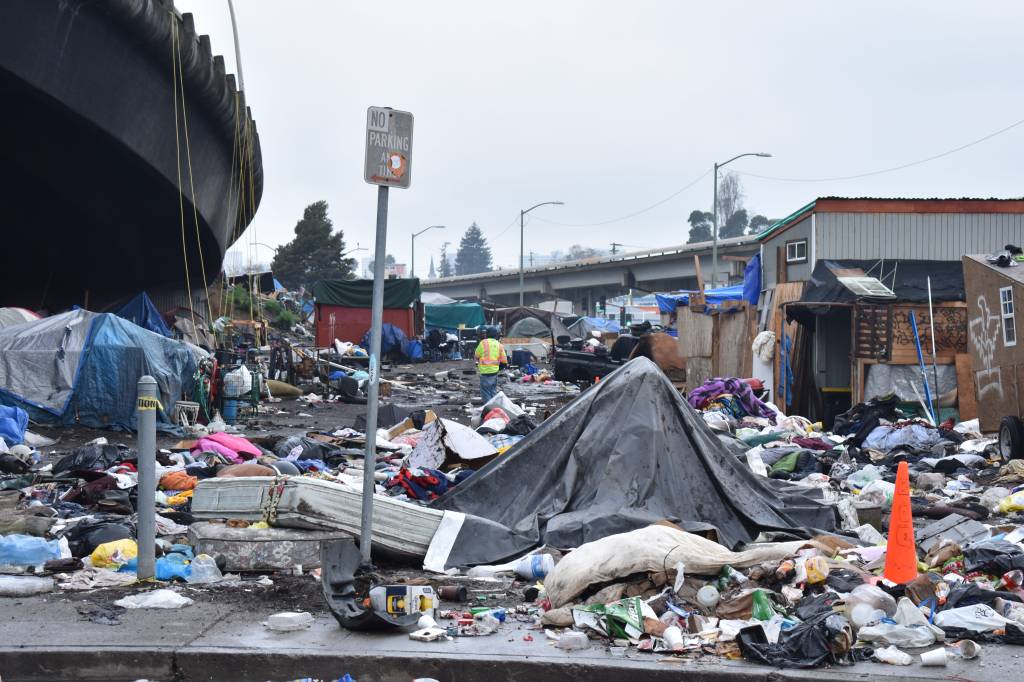
These days in California, if you swap “nuclear meltdown” for “homelessness,” and “Soviet bureaucracy” for “state government,” you discover many of the same patterns of deceit, self-deceit, and manipulation of reality. A homeless person, very likely if not almost certainly from out of town, in the throes of a violent meltdown screaming at passersby and destroying property, is an “unhoused neighbor” in need of “permanent supportive housing.”

Even math doesn’t stand a chance. Last month the Los Angeles Homeless Services Authority (“LASHA”) released the results of the annual homeless count conducted in January (it takes the agency, in concert with a team of academics at USC, six months to do arithmetic). According to LAHSA’s numbers homelessness declined for the first time in six years, with officials claiming a 0.27% decrease at the county level and a 2.2 decrease at the city level. They also reported a 10% drop in unsheltered homeless and a 17% increase in people in shelters.

However, as the inimitable Tim Campell pointed out in a July article for City Watch, “A professor from USC’s Suzanne Dworak-Peck School of Social Work said the county’s margin of error was 1,592—or greater than the reported decrease; the real number of unhoused people could have actually increased. To quote the professor, the supposed decrease was ‘statistically insignificant.'” The reliably establishment Los Angeles Times acknowledged as much, albeit in a single sentence buried deep in its story.

Campell points out that, “LAHSA’s fiscal year 2016-17 budget was $132.1 million, and it had 200 employees. The 2016 PIT count showed 46,874 homeless in L.A. County.  By fiscal year 2023-24, LAHSA’s budget ballooned to more than $840,000,000 and it had 800 employees. The 2024 PIT count showed more than 75,000 homeless in the County. For a six-fold increase in budget, and a quadrupling of staff, the County suffered a 60 percent increase in homelessness.”

Tomato, tomah-toe. Right, the actual Chernobyl. Left, the metaphorical Chernobyl.

That didn’t stop Mayor Karen Bass and the rest of the political class from taking a victory lap. Bass told the L.A. Times that city and county leaders have “changed the trajectory” on homelessness. The CEO of PATH, one of the most rapacious of the predatory nonprofits within the Homeless Industrial Complex, declare the results “an unqualified win.” She must have missed the part about statistical insignificance.

Dr. Margot Kushel, director of the Benioff Homelessness and Housing Initiative at the University of California, San Francisco, told the New York Times that the 2024 count “shows some signs of progress, or at least, bending the curve.” A 60% increase in homelessness over eight years is “progress.” Dr. Kushel, a creature of the bureaucracy whose salary depends on the ongoing crisis, also told the Times, “We’re beginning to do the right things, but we’re not doing them at scale.” 

L.A. spent $1.3 billion on homelessness last year. That’s 10% of the entire City budget, to service 0.1% of the people who live here. Along with LAHSA’s 800 employees the money funds an immense network of nonprofits that collectively employ many thousands of people in every corner of the City. During the pandemic the City received a further $1.3 billion in emergency funds from the federal government to help purchase dozens of apartment buildings and hotels/motels through Project Homekey and convert them to homeless housing. If that isn’t scale, nothing is. Meanwhile, in May Westside Current Editor-in-Chief Jamie Paige and I exposed that some 1,200 Homekey Units, more than half the total, are vacant. Many have been unoccupied for more than two years. That isn’t just scale, it’s failure at scale. Who’s peddling the misinformation here?

Statements like Kushel’s bring to mind a particularly tragic aspect of Chernobyl. Aside from the three protagonists who are portrayed as crusaders for truth, the only people willing or able to acknowledge reality are on their death beds succumbing to the horrors of acute radiation poisoning. Everyone else is invested in the lies. Does Dr. Kushel actually believe what she told the Times? The disconcerting answer is that it doesn’t matter. Like the fictional Zharkov, she expects the faithful to abide.

Through all of it, left unmentioned were the many problems with this year’s homeless count, most significantly the repeated crashes of the smartphone app volunteers used to record their numbers. It was the third such experience in three years (here are my stories from 2022 and 2024, and CBS News story from 2023). My reporting on the 2022 prompted an investigation by CBS News, which I helped produce. The facts are out there in plain view: Different apps, on which LASHA spent millions, crashed in different ways, rendering the data compromised if not useless. 

Yet the agency and the political class continued to hold up the counts as the gold standard as they took that victory lap. It isn’t the first time. In 2022, I volunteered for the count at and around the Venice Boardwalk, along with two friends. We counted 279 people living on the streets and sidewalks, on the Boardwalk, in Westminster Park, and in vehicles, campers, and RVs. However, when LAHSA released the official count results five months later, they reported zero people in our tract. Zero. Nevertheless, at the press conference announcing the results, LAHSA officials were upbeat “There are lots of good things in the numbers today,” said one official.

Again, where, exactly, is the misinformation coming from?

“Data,” LAHSA style. Left, the piece of paper my volunteer group and I ended up submitting after the smartphone app crashed in 2024. Right, the text I sent to the personal phone of a LAHSA employee after the smartphone app crashed in 2022.

Despite substantial anecdotal evidence and a growing body of data to the contrary, the political class also insists that 90% of homeless people in California became homeless in the city in which they last had housing. As such, it is the state’s (via counties and cities) responsibility to shelter and ultimately house them wherever they happen to be. In a favorite progressive phrase, we must “meet them where they are.”

Yet San Francisco, long the most tolerant of California cities when it comes to street homelessness and even vagrancy, recently instituted a policy that requires service providers to offer people free bus tickets out of town before offering them shelter. To be eligible, an individual has to demonstrate a familial or other existing connection to their destination – including a prior address. Personally, I have spoken with, interviewed, and otherwise interacted with scores of homeless people throughout L.A. A substantial majority were from out of town.

For example, during the pandemic I interviewed a group of homeless people living in a park on the West Side. Of the dozen odd people in the camp, not one was from L.A. A couple were from Riverside (they claimed). Two were from Oregon, two were from Utah, one was from Tennessee, one was from South Carolina, and one was from Florida. The others didn’t want to share personal details, and it’s safe to assume they were from elsewhere as well. Several were ex-felons. The guy from Utah had served 17 years in a Colorado Supermax prison for stabbing another man to death on the Venice Boardwalk. After release he literally returned to the scene of the crime and took up residence.

We aren’t just importing homeless people, we’re importing homicidal maniacs. Remember that next time George Gascon claims with doe eyes that “we never could have seen this murder coming.”

Aside from being out-of-state imports, what most of those park dwellers had in common was a refusal to accept any sort of communal shelter or housing. For several that included refusing an apartment. The man from Tennessee, who’d also served time in federal prison for a crime he wouldn’t reveal, said he had PTSD from prison and would only “accept” a free house.

Like the Soviets’ response to Chernobyl, California’s response to homelessness stubbornly ignores these realities. Instead, it has been doctrinal. In the words of the NPR affiliate KQED, the notion that many homeless people in California are from elsewhere is a “myth.” In California, reality is mythology. Leonid Brezhnev would be impressed with our political class’s alacrity. That goes a long way toward explaining how the state has spent $24 billion on homelessness in just the last five years, with almost no oversight or accountability, only for the problem to continue metastasizing.

The political and bureaucratic class don’t just perpetuate false information, they actively cover up the truth. The independent, nonprofit news outlet CalMatters faced eight months of stonewalling from LAHSA when journalists attempted to obtain public records related to violent incidents within L.A.’s homeless shelters and housing. The incidents include violent sexual assaults, overdose deaths, and murders. This week the news organization filed a lawsuit to force the agency to release the records.

The “Chernobylization” of California government

This “Chernobylization” is on display on issue after issue after issue. “Vision Zero” is a transportation policy that redesigns roadways with the promise of eliminating fatal and severe injury accidents. In Los Angeles, after nearly a decade of Vision Zero, traffic fatalities have nearly doubled. The data is irrefutable. The policy has resulted in increased serious injury and fatal accidents in San Francisco, Sacramento, San Diego, and elsewhere. I have written on the issue extensively. Yet the political class carries on, doubling, tripling, and quadrupling down on bike lanes, road diets, physical obstacles, and other distractions in the name of safer streets. It doesn’t even matter that these projects have proven catastrophic during mass emergencies. I have written about the impacts of road diets on evacuations out of Paradise during the 2018 Camp Fire and during the 2017 La Tuna Fire, the largest in the history of the City of Los Angeles. I and others have videoed fire trucks, ambulances, and police cars bogged down on narrow, obstacle-filled road diets.

Despite these frightening realities, the political establishment insists say we “must to do more.” More Vision Zero, more road diets, more confusing obstacles on roadways. In California, peril is safety.

More official “progress.”

Similarly, consider the political class’s professed commitment to environmentalism and sustainability. They tell the people that covering thousands of square miles of virgin ecosystems with Chinese manufactured solar panels and wind turbines that require enormous volumes of petroleum based lubricants while devastating local ecosystems and animal species, particularly birds, is “sustainable.” These wind and solar farms can be seen from space. It’s hard to describe the cumulative impacts of these massive projects. You have to see them for yourself. They are harrowing. Of course, because wind and solar are intermittent, they require backup by massive, chemical intensive batteries as well as conventional power plants, of which nearly 40% are powered by natural gas or coal. Energy author and journalist Robert Bryce has written extensively on these realities.

We are told that allowing a global private equity firm to destroy some 4,200 protected Joshua Trees and remove hundreds of endangered desert tortoises in the Mojave Desert to make way for a 2,800 acre solar farm that will provide electricity to wealthy cities on the coast and in Silicon Valley is necessary to protect the environment (the Department of Fish and Game issued the permits in 2021 when the trees were subject to a provisional act protecting them; the permanent law was passed in 2023). In the context of this development, the cherished trees have become “large natural obstacles” impeding construction of an immensely profitable industrial site. The requisite transformers, underground cable conduits and heat exchangers, storage batteries, transmission lines, and other infrastructure will require still more land.

A spokesperson for the company developing the solar facility told the L.A. Times, ““While trees will be impacted during project construction, vastly more Joshua Trees are being threatened by climate change caused by rising greenhouse gas emissions, which the Aratina solar project directly addresses.” We must destroy the environment in order to save it. Meanwhile, in 2021 a couple in San Bernardino were fined $18,000 and charged with 36 misdemeanors for removing 32 Joshua Trees to build a house. The couple were cited under the provisional act even though they believed the particular trees they removed were exempt. Rules for me, and not for thee.

“Environmentalism,” California style. Courtesy Sustainable Environment.

These inversions of reality are happening at a national level as well. During the 2020 election and well into the Biden presidency, the FBI, NSA, and individual elected officials, pressured Facebook, Twitter, and other social media platforms to censor truthful reporting that was harmful to Biden, particularly related to the politically devastating contents of Hunter Biden’s laptop computer. The truth became “Russian misinformation.” The story was subsequently validated, and became an ongoing headache for an administration that had promised transparency and honesty after four years of Trumpian lies and distortions. Instead, “misinformation” became “anything politically harmful to the ruling family.” That’s chilling.

The most egregious examples relate to President Biden himself. For two years the country was told that he was “sharp as a tack,” and that Americans shouldn’t believe their own lying eyes and ears when he spoke gibberish, tumbled up stairs, wandered off stages, and stared blankly into space. Anyone who argued to the contrary was accused of — wait for it — spreading misinformation. The establishment protected him as long as they needed to, then after his disastrous June 23 debate performance they politically shivved him in what Maureen Dowd at the New York Times described as a coup d’etat (the August 17 headline was “The Democrats Are Delighted. But a Coup Is Still a Coup”).

We are now told that Kamala Harris, the chief beneficiary of that coup who has received — counting on my fingers — precisely zero votes compared to Biden’s 14 million, is the defender of democracy. Meanwhile the establishment have all but memoryholed Biden himself in the month since he announced he wouldn’t seek reelection. He’s been on vacation, don’t you see. It’s not like the world is on fire or anything.

“Misinformation” is whatever the political class says it is

What, then, exactly, is “misinformation?” It would seem that in our postmodern, Foucaltian era the answer is, “that which is inconvenient to the political class’s chosen narrative.” Americans have heard a lot about fake news over the last eight years. What we need to be paying attention to here in California is fake reality. The examples in this post are but a fraction of the story. It can be downright surreal, to the point of cognitive dissonance, to experience the yawning chasm between what Californians see and experience on a daily basis compared to what is reported in so much of our legacy media.

Free speech, the most essential right, the freedom upon which all others rely, is, of course, the ultimate inconvenience. That’s its whole point. Free speech is inconvenient, uncomfortable, sometimes outrageous and infuriating. The people, the voters, ought to be inconvenient to the political class. Just because Karen Bass, or Gavin Newsom, or the Los Angeles Times says it doesn’t make it true. There was a time, not so long ago, when Californians, and Americans in general, retained a healthy skepticism. We need to reclaim that independent thought.

During the Vietnam War, the Democratic Lyndon Johnson and Republican Richard Nixon administrations routinely lied to the American people about the country’s successes on the battlefield. Defense Secretary Robert McNamara, the war’s chief architect, gave macabre weekly press conferences in which he boasted about enemy body counts. Officials smeared anti-war activists as unpatriotic peddlers of misinformation. The FBI, CIA, and NSA monitored individuals and groups that inconveniently challenged the government’s preferred narrative, from Martin Luther King, Jr. to freelance journalists and individual anti-war activists. It was governmental paranoia comparable to that which Chernobyl so effectively captured. Fortunately for the nation the people won that round, and two successive Presidents were forced to abdicate, albeit for different reasons.

Thanks to modern technology and the Internet, today’s governmental bureaucracies have surveillance and censorship powers that are orders of magnitude beyond even Tricky Dick’s wildest fever dreams.

That same technology also empowers regular people to sniff out the political class’s lies. Their power to control the narrative is, for the first time in history, nearly approximated by the people’s ability to suss out the bullshit. Tim Campbell’s CityWatch essay, and his excellent dismantling of the official L.A. homeless numbers, is out there for all to see. Like this blog, outlets like CityWatch are part of a modern day Samizdat, the ecosystem of underground dissident publications in the Soviet Union. Perhaps that sounds a bit vainglorious, but it’s increasingly true. The Los Angeles Times, the San Francisco Chronicle, and other legacy media outlets are hopelessly compromised. It’s difficult to conjure a memory of the last time the L.A. Times wrote anything critical about the political class. It takes nothing less than criminal indictments for La La Land’s Pravda to so much as acknowledge that maybe, just maybe, everything isn’t quite as rosy as they so often make it out to be.

Misinformation, indeed.