At a time of increasing social discord, places of worship are among the last sanctuaries for everyone
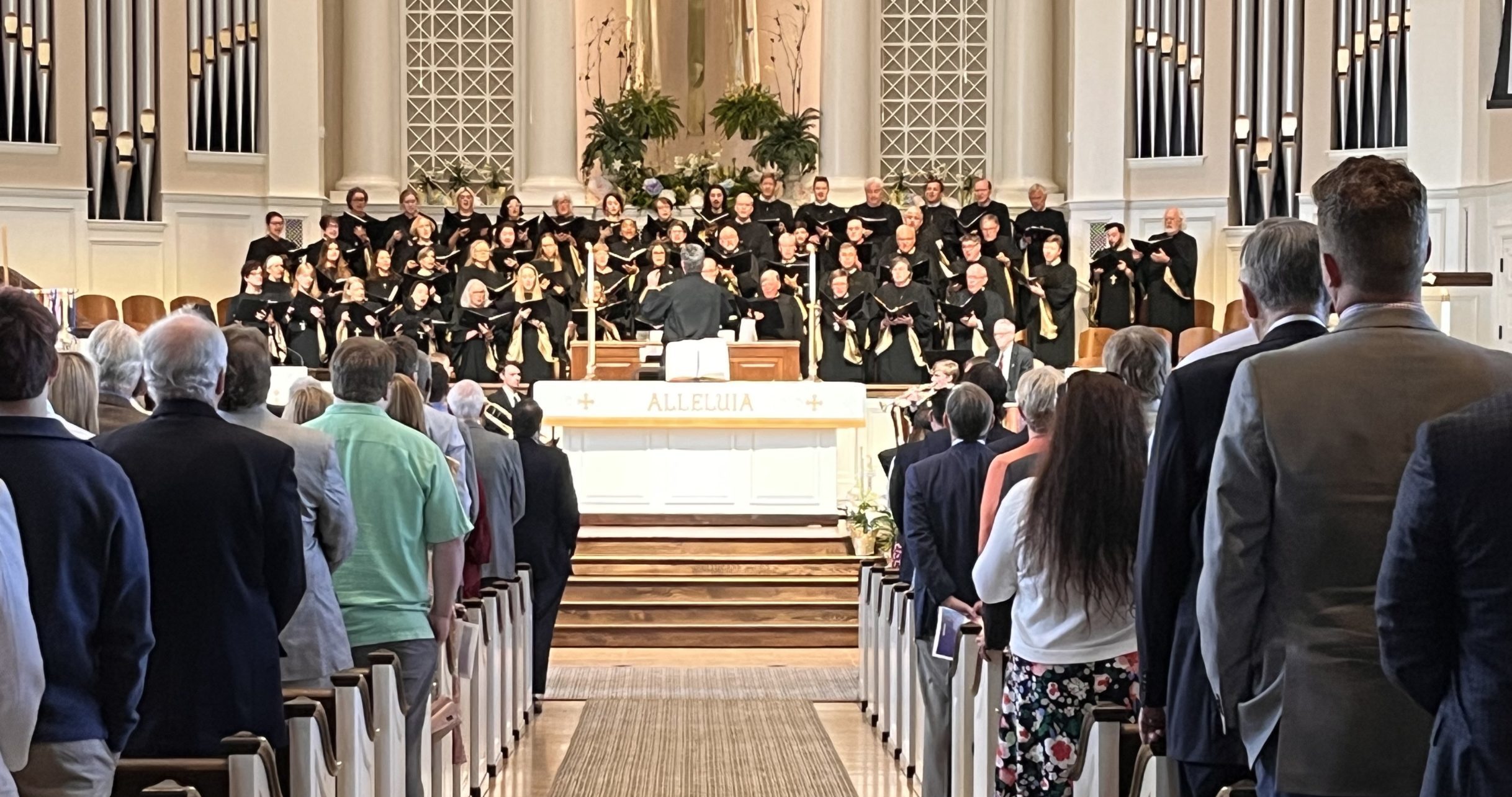

One of these gatherings is peaceful, tolerant, and inspiring. One is not. (File photos)
I’ll get one thing out of the way right up front: I’m a hypocrite. A fraud.
I don’t believe in the Judeo-Christian God, nor do I believe that Jesus Christ was the son of said (nonexistent) God. I don’t believe in the Resurrection, and I do not expect Jesus to return to Earth. I do not believe that Moses parted the Red Sea to assist the Jewish exodus from Egypt. I do believe in the extraordinary and even the extraordinarily coincidental, such as the possibility that an extremely rare weather phenomenon occurred in or near the Red Sea at precisely the time and location where the Jewish refugees needed it, and that such extraordinary coincidences may well reflect the influence of something beyond. But I do not believe individual human beings can intentionally work miracles.
When all is said and done I believe that the primary difference between organized religions going back to Zoroastrianism is their respective degrees of bonkers. I believe that no human religion or philosophy has come anywhere within a hundred million light years of understanding or explaining the universe, much less creation, and that for all of humankind’s peering into the cosmos, for all our yearning for something beyond ourselves, we still don’t even know where to start looking. I sincerely doubt that it is “God” or “gods” in any of the myriad ways that human beings have ever conceived of him/her/them. I believe in something bigger than us mere mortals, but these days I’m more inclined to believe in simulation theory than anything else.
Despite these sincerely held (non?) beliefs, I frequently go to church. When I do attend services it’s usually one of the highlights of my week. I find a solace, peace, and fellowship in those pews, bathed in stained glass and embraced by music, that is nearly impossible to replicate in any other human institution these days. I would go so far as to call it miraculous, though as I said I do not believe in miracles.
My version of going to church isn’t just hypocritical, in a way it defies a core tenet of the faith, because it is largely based on my personal ego. I even refer to it as “my” version of church, as if there is such a thing. Of course, the point of church is that one leaves one’s ego at the threshold, but here I am, making it all about me. Allow me to explain.
We’re like, spiritual, man
Like many millions of Gen Xers raised by Boomers, religion was not a particularly important part of my upbringing. My mother is a lapsed Catholic and my father was traumatized to the end of his days by his fundamentalist Baptist upbringing in a deeply impoverished region of California’s Central Valley. When I was growing up we celebrated Christmas and Easter as secular holidays focused on presents and chocolates, not liturgies and Eucharists. At the same time, we had many Jewish friends and neighbors — about half my classmates in elementary and middle school were Jewish — and so we also recognized Hanukkah and Passover. The menorah our next door neighbors gave me when I was six or seven years old went up on our mantel every December, right above the Christmas stockings. I have a particularly fond memory of elementary school holiday musicals, when we’d sing a mashup of “Christmas is Coming” and “Hanukkah Shalom.” The holidays were cherished traditions that had little connection to their religious origins.
I knew Christmas was a celebration of Jesus’s birth, of course, but the closest I got to Jesus himself during the holidays was listening to Linus’s rendition of the story of Christmas on “A Charlie Brown Christmas” (which soliloquy still makes me go misty).
There was also the broader context of society’s move away from religion in the second half of the Twentieth Century, and away from most traditional sources of social and community cohesion. Organized religion was one of the biggest casualties of the generational temper tantrum known as the Sixties, a period demarcated and remembered as much through caricature as reality. Religion, particularly Christianity, became shorthand for every thoroughly secular sin from the marginalization of women to colonialism and racism. Which is, of course, ironic if not ignorant, given the essential roles churches and synagogues played in the Civil Rights and Abolitionist Movements.
To be sure, religious institutions provided plenty of fodder for their own demise – in the 80s the world learned of the first Catholic Church sex scandals and witnessed the rise of the modern televangelist movement with its many rapacious charlatans, the sorts who didn’t let a few pesky commandments stop them from ripping off the AARP set. Starting in the 1970s Christian groups formed the backbone of the anti-abortion movement, which was the end of any possible compromise with their former liberal allies.
As such, unlike those Bible thumping rubes in the midwest and south, we on the coasts was convinced we was edumacated. We knew better.
Except, of course, we didn’t. We were right on a few things — especially women’s bodily autonomy and LGBTQ rights — and very, very wrong about a great many other things. Yes, many churches were irredeemably corrupt. Yes, when Catholic priests weren’t thundering about the eternal damnation that awaits homosexuals they were diddling altar boys in the sacristy. So to speak. The hypocrisy was all we needed to justify turning our backs. At the time it even made sense.
Except, of course, the vast majority of priests were not abusing children. The vast majority were tending to their congregations, providing hope to the hopeless, giving counsel to the lost, performing baptisms, marrying young couples, helping families say good-bye to the departed, operating food banks and other charitable endeavors in their communities, and so on. Most of all, they were providing welcoming, convivial sanctuaries at a time when such places were increasingly scarce.
Moreover, we also learned that while abominable the church’s sins were hardly unique. Suffice it to say, when it comes to the institutionalized exploitation and abuse of children Randi Weingarten could give Pope Francis a run for his money. Public and private schools, the Scouts, local police activities leagues, kids’ sports programs, and on and on, basically anyplace children congregated in any numbers attracted its share of perverts. Nevertheless, we threw out the proverbial baby with the bathwater. In a very real way, religion was the woke movement’s first scalp. Millions of Americans who otherwise had healthy relationships with religion turned away, based on theory.
Just enough?
For reasons that elude me to this day my parents did decide to go to church for a couple of years when I was in middle school – perhaps they sensed my budding iconoclasm, which is a fancy way of saying that by puberty I was already a reflexive contrarian.
I never particularly enjoyed sacrificing half of one of two precious weekend days, and I really hated getting up at 6:30am on Sundays to get ready for an 8am service. My parents kept at it long enough for me to become an altar boy, which if there does happen to be a God must have been good for a chuckle on his part. Then we moved to Northern California when I was a sophomore in high school and that was the end of that.
My apostasy continued into early adulthood. I attended a Catholic university without ever once stepping foot inside the campus chapel. My final thesis in the one theology class I took focused on Nietzsche, because I knew it would annoy my pious professor. For a while I dated a devout Catholic girl who sometimes interrupted our make-out sessions to go to Mass (I may occasionally have attempted to persuade her to abandon her faith, and I stand by those efforts: There was necking to be done, and she had built up enough goodwill by the time we met to justify skipping an oblation or two in service to Eros).
Additionally, over the course of my life I’ve had the great good fortune to have visited sacred places including the Vatican, Notre Dame Cathedral, the Marian Shrine in Lourdes, and the Hagia Sophia. While all are stunning in their own ways, none aroused a sense of religiosity in me. In fact, I felt somewhat nauseous in St. Peter’s Basilica, with its overwhelming wealth of gold and splendor on display, much of it pilfered, all in the name of a man who preached poverty and humility. I wanted to shout, “What part of ‘the meek shall inherit the Earth’ was unclear to you people?”
Michelangelo’s Sistine Chapel frescoes and the dome of the Hagia Sophia, in contrast, did stir my soul. Still, those feelings paled in comparison to the sheer overpowering awe I’ve felt at the summit of Mt. Rainier, the base of Bering Glacier, or the precipice of Arizona’s Canyon de Chelly. In short, by the time I was fully ensconced in adulthood religion played no role in my life. I was not an atheist (too presumptuous and arrogant, that) but I felt zero connection to any particular organized faith or God.
I was, like, “spiritual,” man.
Nothing like a little pandemic to help you find religion
Then came COVID-19. Like a huge number of Americans, for close to two years I frequently found myself grappling with a whole new manifestation of the concept of “lonely.” I had recently gone through what turned out in retrospect to be a catastrophically poorly-timed breakup. I went on precisely one – promising – date in the first week of March, days before the gates literally came crashing down on the world. They even shut down the damn dog parks.
As soon as California loosened restrictions – long after most of the rest of the country, it’s worth noting, which is Reason #337 Gavin Newsom should never be allowed anywhere near the Oval Office except as an infrequent visitor – I sought ways to reconnect with my fellow human beings. This, it must be noted, does not come naturally to an otherwise grumpy misanthrope such as myself.
That said, as I age and pretend to acquire something resembling wisdom I have attempted to temper my more misanthropically misanthropic tendencies. For example, I no longer mutter passive aggressively under my breath at the person in front of me at the grocery store who fumbles for thirty seconds trying to find the credit card they had several perfectly good minutes to have fished out while waiting in line, but no, they had to finish that f****g game of Candy Crush instead because Allah f****g forbid they show the slightest f****g courtesy to their fellow shoppers, whose time obviously is far less valuable and who in any event are going to live forever so please, play your f****g game while the rest of us stand here aging. Also, it’s been entire hours since I gave another driver the International Salute of Friendship.
See, human beings can grow!
Among my efforts, I decided to start going back to church. Or rather, I decided one weekend to attend a service at St. Monica’s Episcopal Church in Santa Monica, aka “St. A’s.” I had precisely zero expectations. Again, it was born of a desire to reconnect with other people, not some sort of spiritual hunger. Suffice it to say, I was more than pleasantly surprised.
For starters, there was more diversity in that small congregation than one typically sees in Santa Monica, or the Westside in general. On my first visit I met Caldwell, a black man who was one of the first non-white homeowners in Brentwood, the grandson of slaves on both sides of his family. I met a board member of the California Science Museum who played a key role in bringing the Space Shuttle Discovery to Southern California. Despite the fact that I grew up and went to school in West Los Angeles, West Hollywood, and San Francisco and have had many friends and colleagues in the LGBTQ community over the years, the first trans woman I ever met (knowingly) was at that church. Also at that first service, before delivering his sermon the priest invited a married couple up to the altar. Turned out they were among the first lesbian couples to get married in California — before it was legal — and they had gotten married at St. A’s. They were celebrating their 20th anniversary.
Moreover, those initial meetings bore fruit for a long time after. I ended up working with Caldwell to raise seed money for a new veterans’ nonprofit (he himself is a Korean War vet). One of our first meetings was at L.A. City Hall. From the tower I could see the little notch in the San Gabriel Mountains near Monrovia where my great great great grandparents settled and built the first sawmill in the 1850s in what was then the newly U.S. town called El Pueblo de Nuestra Senora, Reina de los Angeles del Rio Porciuncula. Along with Caldwell, grandson of slaves, was Ernesto, who works for the City Arts Department and is the son of immigrants. Rounding out our little crew was a female deacon from St. A’s, a Ph.D. who works at the Rand Corporation. We ultimately raised more than $250,000, much of it through meetings in the multipurpose room at St. A’s.
Another thing I came to appreciate about church is that it’s one of the vanishingly few places I have witnessed and experienced true equality. During the post-Communion exchange of greetings multimillionaires shake hands and embrace homeless people, at the post service coffee klatch Ph.D.s engage in dialogue with high school dropouts. For a brief 75 minutes identity, race, experience, education, gender, orientation — none of it matters. Or rather, every conceivable combination and permutation is accepted without question. Politics matter least of all. Pardon the pun, but Good Christ is it refreshing. I daresay I leave services with a bit of my faith in humanity restored, even if my faith in God remains absent. In a small way, there is something miraculous about that: You don’t need to believe in order to benefit. Name another human institution about which that’s true.
It’s an exceedingly low pressure church, even by the generally low pressure standards of American Episcopalianism. There are no expectations: During the Lord’s Prayer I bow my head in respectful silence, and during Communion I remain in the pew in silent meditation (to paraphrase Doc Holiday in Tombstone, my hypocrisy knows at least some boundaries).
What there is, is a sense of community, of fellowship, of belonging. I’ve met some of the smartest and most accomplished people I’ve ever known at St. A’s. Most importantly, the thing that keeps me going back, is that there is an innate sense of trust in church. You can feel the barriers that normally separate people drop for a little while. We are all there together, we are all there to seek something in common and to offer something in return, even if our offering is merely our presence. It’s a feeling that is in desperately short supply in this country these days: Human beings being vulnerable to complete strangers. It’s reassuring.
One might go so far as to say, it is godly.
Even the godless can feel godly
Earlier this year, it had been a few months since I’d gone to church, so I decided to attend the 11:00PM Easter Vigil at St. A’s. It was spontaneous. I’d never attended a Vigil and had no idea what to expect.
A quick Google search informed me that it is the most important service on the Anglo-Catholic calendar. Who knew? No less than St. Augustine himself called it “The Mother of All Vigils” (which for some reason put me in mind of a vigil rampaging Godzilla-like through a large American city, but I digress). It recreates the vigil that Jesus’s mother Mary and his disciple Mary Magdalene held at the entrance to his tomb after the crucifixion, culminating with their discovery on the third morning that Jesus was gone. In my ignorance, it seemed like a good time to bring some church back, kind of like going to service on Christmas or Easter itself. Low stakes stuff for a random Saturday evening
In fact, the evening would wallop me in the head and punch me in the solar plexus, delivering the closest thing I’ve ever had to a religious experience.
Unlike a normal Sunday morning service the church was dark, nearly pitch black. A few spare candles provided almost sickly halos, as if even light itself had no place in the scene. The altar was blanketed in rough sackcloth, as was the pulpit, and the crucifix was obscured by a purple shroud. There were no other colors, and the soothing sounds of the background organ were absent. It was nearly silent, it was dark, it was cold. It felt like — well, a tomb.
As I took a seat I felt death in that church as nothing less than a physical presence. I flashed to the last time I saw my father, before they sealed him into the coffin and I threw the lever that sent him into the crematorium (I’d be damned if anyone else was going to perform that task). I flashed to sitting death watch for two dear friends succumbing to cancer. I flashed to the airshow I attended when I was 11 years old, where a Navy F/A-18 fighter slammed into the ground and burst into flame. My every experience and contact with death replayed through my mind, almost in sequence. It was inescapable. It hit me like a haymaker to the jaw. I literally stumbled through the darkness to the courtyard where the service would begin around the Paschal flame.
In the courtyard, as we congregants huddled in the cold and lit one another’s spindly little candles, Father Nate began, “We believe that Jesus Christ died for the forgiveness of our sins, that he rose from the dead to eternal life, so that we too, might live forever. We need not fear what Death has in store, because Jesus Christ went ahead of us, to light the way. Tonight, we welcome Death into our sanctuary. We welcome Death, secure in the knowledge that our Lord Jesus Christ will deliver us from it, into eternal life.”
Which was when it hit me like a thunderclap: The courage. The courage of a faith that invites the thing human beings fear most into its most sacred, hallowed space, on one of its most sacred days, gives it a seat in the front, and looks it in the eye. For those few minutes we few score congregants in that darkened courtyard communed with Death, fearlessly. Living the story of the death of Jesus, a particularly horrific death that echoes through the millennia. As Father Nate delivered the Old Testament readings, I found myself weeping.
The congregation then processed back into the church, where Father Nate offered the final prayer in darkness. Then lights snapped on and the church bells began to ring. The organ boomed to life in a massive crescendo and the light flooded the chamber. The choir struck up Handel’s Messiah as the congregants rang our own little hand held bells and shouted our “Hallelujahs.” For it was the first minute of Easter Day, the day of Jesus’s resurrection (you know, if you believe in that sort of thing). Death was cast out as ignominiously as an obnoxious drunk at a dive bar, kicked to the curb for another year. The fever broke, the fear washed away with the light, and people embraced.
There are precious few places left in this country where people can experience something like that, and those places are as desperately needed today, in this moment, as at any point in our history. If some of them come with some God thrown in, that’s just fine.
I’m still a hypocrite, but I’m a hypocrite who has come to value, even cherish, that which I previously dismissed out of hand. Suffice it to say, sitting in City Hall tower with a group of individuals who could not have been more different and diverse, I thought a lot about that little church in Santa Monica. There we were, in a public building, in the people’s building, united in a common cause that was bigger than any one of us. During those meetings I felt like my hometown, battered and beaten by events, still stands a chance, maybe even a good one.
It all started when I shook a complete stranger’s hand in the pews in that little church, embraced him, and exchanged words that may well be miraculous after all: “Peace be with you.”
 the all aspect report