The driverless taxi company doesn’t even pretend to give a rip about the human beings it’s experimenting on
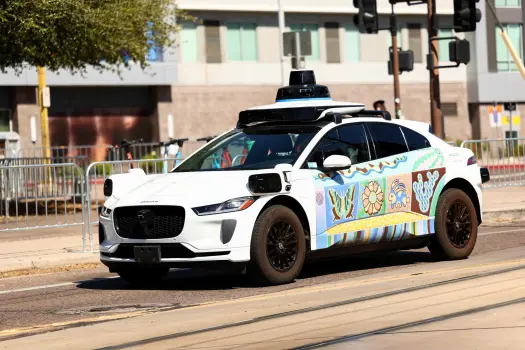
The artwork in which Waymo has started bedecking some of its vehicles doesn’t cover over the fact that the company is run by a bunch of contemptuous asshats.
When it comes to technological advances, the autonomous ride hailing company Waymo is a prime example of the adage that just because we can do something, doesn’t mean we should. Ever since they started showing up in large numbers on the streets of San Francisco, Los Angeles, Santa Monica and Phoenix, the company’s vehicles have caused all manner of inconveniences and disturbances. Despite the company’s boasts they also raise safety concerns.
At first, the company — which is owned by Google parent Alphabet — kinda, sorta half responded to the issues they themselves were creating. For example, over several weeks this summer, Waymos in a San Francisco parking lot woke neighbors at all hours by continuously honking at each other. Neighbors complained, local news covered the story — and the company announced fixes. Except the honking continued for several more weeks. It turned out that the vehicles were parking too close to one another, prompting them to honk at each other. It was an example of how the company rolled out its product at scale before all the bugs were sussed out.
Forced experiments on humans
It’s one thing when, say, a social media platform or dating app uses its customers as guinea pigs. People can choose to not use the sites or apps, or use various methods to limit the extraction of their personal information.
In contrast, Waymo is unavoidable. The company forces everyone who lives in cities in which it operates to be its test subjects. Every time a Waymo SUV goes by, its 36 cameras are recording high definition videos of everyone it passes. When a Waymo parks in front of your home, its cameras are peering through your front windows and recording everything. When a Waymo is behind you in traffic, when you pass in front of one in a crosswalk, you are an involuntary test subject helping to train its AI. What else the company is doing with those terabytes of images and videos of millions of people is anyone’s guess — it’s not the most transparent of companies.

Private eyes are watching you.
The real world implications of the company’s live action human experimentation are considerable. In October, Waymo Co-CEO Tekedra Mawakana acknowledged to an audience at the annual TechCrunch convention that the company’s vehicles had “challenges with blocking emergency vehicles,” and that they “pump the brakes” and “reset all the time.”
Again, it’s one thing to work out the bugs on a website as customers use it. It’s something entirely different when the experiments involve hundreds of 5,000 pound SUVs traveling at 40 miles an hour.
Apparently they aren’t pumping the brakes enough. Just last week, a Waymo was recorded driving through the middle of an armed police standoff with a suspect in a pickup truck. At least half a dozen police vehicles with flashing lights are visible in the video as the Waymo pulls through as if nothing’s happening. A human being would be arrested for doing that. Similarly, I’ve spoken with several police officers in Santa Monica who confirmed that Waymos often fail to pull right when police cars approach from the rear with lights and sirens. Things have gotten bad enough that the company worked with the Governors’ Highway Safety Association to issue guidelines to first responders on how to interact with their vehicles.
Stop and ponder that a moment: Rather than fix its own technology so its vehicles never get in the way of emergency responders to begin with, a private tech company with an estimated market value of $100 billion shifted the responsibility to the responders themselves. That’s some breathtaking hubris.
Bad drivers
While the company’s large SUVs have not been involved in any fatal accidents — at least, none that have been reported — recent stories reveal that they have begun driving more aggressively. They’ve been recorded making illegal u-turns, rolling through stop signs and zigzagging through traffic. This bad “behavior” is a direct result of decisions made by the human beings who work at and run the company. Mind you, they’re programming their cars to be more aggressive even as numerous safety concerns remain unresolved.
In recent weeks Waymo vehicles have ran over and killed a cat and a dog. According to the dog’s bereaved owners the vehicle made no attempt to stop or slow when the dog appeared in front of it.
Earlier this year, I had a near miss encounter with a Waymo. I was in a crosswalk with my dog on Ocean Avenue in Santa Monica. As I crossed, a Waymo made a left turn onto the street and entered the crosswalk. It passed within a foot of me and my dog without stopping or slowing, and cut off a human driver in the intersection, who had to slam on her brakes. The driver and I exchanged incredulous looks. My efforts to contact the company and report the incident were ignored.
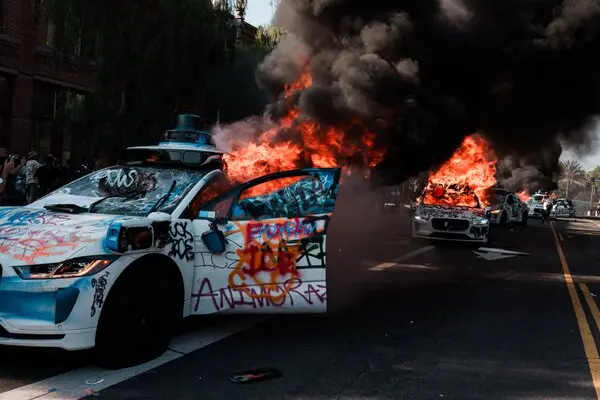
Earlier this year, rioters set three Waymos on fire in downtown Los Angeles. It is impossible to convey in words how much joy this scene brought me.
Social media and YouTube are replete with videos like this one, titled “I thought my Waymo was gonna kill me.” Videos include a Waymo with a passenger in Phoenix driving in continuous circles around a roundabout, and Waymos in San Francisco driving down the wrong side of the street, getting into a standoff with each other and clogging up a street, andinterrupting a Veterans’ Day parade. Wrong way driving and ignoring traffic laws appear to be particular concerns. Last July a police officer in Phoenix pulled a Waymo over for driving on the wrong side of the road.
Safe — kind of, sort of, with a big grain of salt
According to the most recently available numbers, its vehicles have covered around 100 million driverless miles with a single fatal accident, for which the Waymo reportedly was not at fault. Superficially, that’s better than human driven vehicles, which are involved in a fatal accident every 80 million miles. In contrast, after Tesla rolled out its “autopilot” feature; it was implicated in at least 40 fatal and severe injury accidents, prompting a recall (thanks, Elon).
However, Waymo’s safety record needs to be taken with a big grain of salt. Waymos operate almost exclusively on lower volume roads and residential streets where severe accidents are rare. I’ve never seen a Waymo, for example, on Montana Avenue or Wilshire Boulevard. They don’t yet operate on freeways. They don’t operate in bad weather. The comparison between Waymo and human driven cars is not apples to apples. If anything, the numerous problems that plague the company call its safety claims into serious question.
Bad neighbors
Along with concerns about safety and “behavior,” the company’s operations create quality of life issues. As I previously wrote about and documented, for several months earlier this year Waymos would park on my residential block dozens of times a day, taking up valuable parking spaces. Sometimes two or three would park simultaneously. Their parallel parking skills left much to be desired. The result was that the large SUVs routinely took up the equivalent of as many as half a dozen spaces on a single block. Elsewhere, I’ve seen Waymos parked in red zones and at expired meters. On at least one occasion, a Waymo on my block received a parking ticket for violating street cleaning restrictions.
On one hand, Waymos are doing things that human beings do all the time. Then again, that fact undermines the central rationale for driverless vehicles, that they are safer and more responsible than impulsive humans.
And then there’s the noise the vehicles emit when they back up, a sort of half beep half warble that seems to have been engineered specifically to drive human beings insane, especially when they are subjected to it dozens of times a day. It immediately had a significant psychological impact on me and my neighbors. It was like death by a thousand audible paper cuts.
It became a significant quality of life disturbance, especially when the vehicles started operating in the evenings and nighttime. Beep. Beep. Beep. Beep. At all hours. I began having auditory hallucinations, especially at night, convinced a Waymo was backing up when one wasn’t there. My next door neighbor started waking up several times a night. Our efforts to contact the company and report the problem were roundly ignored. We reached out to the Santa Monica Police Department for help. The company even ignored them.
Finally, a neighbor and I took matters into our own hands. We placed large palm fronds on the hoods of two parked Waymos, trapping them (they can’t drive with obstructions anywhere on them). We waited for an hour, hoping the company would dispatch human beings we could yell at. When no one showed up, we eventually removed the fronds. Waymos have not parked on our block since. Hallelujah.
The corporate Grinch
Two days before Christmas, the company took its rotten corporate citizenship to a new low. Residents who live near a Waymo charging station in Santa Monica have complained for months that the light, noise and activity create a significant nuisance, disturbing sleep at night and making concentration difficult during the day. Given that one or two or three Waymos on our block were enough to drive my neighbors and I out of our minds, I cannot fathom living next to a place where dozens of the infernal machines operate 24 hours a day. Other issues have included Waymos speeding in alleyways, employees cleaning and vacuuming the vehicles at all hours and employees playing loud music.
It should come as no surprise that none of the company’s “mitigation measures” resolved the negative impacts. Ultimately, the city ordered the company to cease charging operations at night. It was absolutely the right call.
In another example of the company’s hubris, rather than acknowledge the fact that maybe, just maybe, aspects of its operations are having negative impacts on quality of life for actual human beings — who, it cannot be repeated often enough, are being forced against their will to deal with the negative consequences of a tech giant’s experimentation — the company sued the city.

Asshats: Waymo “Co-CEOs” Dmitri Dolgov and Tekedra Mawakana. While I would never call for actual violence, Dolgov looks like exactly the kind of smug ego bag who would benefit from a sock in the face.
The complaint is a master class in corporate grievance hustling. The company’s lawyers wrote, “Waymo’s activities at the Broadway Facilities do not constitute a public nuisance. Waymo faces imminent and irreparable harm to its operations, employees, and customers.”
This assertion arguably constitutes perjury. The company’s operations at the charging station are a textbook example of public nuisance.
In a written statement announcing the lawsuit, a spokesperson keened, “We are disappointed that the City has chosen an adversarial path over a collaborative one. The City’s position has been to insist that no actions taken or proposed by Waymo would satisfy the complaining neighbors and therefore must be deemed insufficient.”
To which the only rational response is, Oh, you poor dears. You’re making millions of dollars off a buggy product that includes some truly crappy features. Rather than fix your own mess, you’re blaming “complaining neighbors” and caterwauling about “irreparable harm.” Remember, this is the same corporate citizen that expects first responders to learn how to get out of its vehicles’ way.
I’ve said it before and I’ll say it again: It’s long past time to tap the breaks on Waymo. I am not opposed to the concept of driverless cars in theory, though I personally don’t see the need for them. I am, however, adamantly opposed to Waymo in particular, based on its consistent poor corporate behavior.
Waymo already was high in the running for Worst Corporate Citizen of 2025. Their decision to sue the city of Santa Monica based on their own bad corporate behavior seals it.
What a bunch of asshats.
 the all aspect report