The career prosecutor and lifelong Democrat has the best chance to defeat the odious George Gascón, repair the damage, and restore justice and compassion in the D.A.’s Office
McKinney is the consensus candidate; other prominent candidates are flawed

[Full disclosure: I work with the McKinney4LA campaign; these opinions are my own and do not reflect those of the candidate or the campaign]
As the 2023-24 primary season started heating up earlier this summer, I spent a good deal of time taking stock of various races here in L.A. and the candidates vying for office. There are several promising candidates on the upcoming City Council races, like Adrin Nazarian in CD 6 and Ethan Weaver in CD 4. Despite a recent ethics scandal, the Council’s sole Republican, John Lee, likely will secure reelection. Meanwhile, three of Los Angeles County’s five Supervisors are up for reelection; unfortunately, only one of those races is competitive, with District 4 Supervisor Janice Hahn facing challenges from former L.A. County Sheriff Alex Villanueva and current Rancho Palos Verdes Councilman John Cruikshank. The other two Supervisor races are headed for the democracy-free zone with which Angelenos have become depressingly familiar. More on those races in a later post.
With few exceptions, in 2024 the Los Angeles electorate’s appetite in is shaping up to be decidedly moderate. Like teenagers discovering vodka and Red Bull for the first time, in 2020 and 2022 we binged on the artificial, toxic rush of radical “Democratic Socialist” candidates including four members of the L.A. City Council, two Supervisors, and the District Attorney. The (predictable) results have been spiraling crime rates, including massive increases in unreported crimes, along with degraded quality of life and less prosperous communities. The further removed we get from the death of George Floyd and the long hot summer of 2020 the less sense it all makes, the more rash it all seems. Now, in the cold light of dawn Southland voters have a Category 5 political hangover and a serious case of morning after regret. We have been doing the political walk of shame, and in 2024 we have a chance to restore our communities and our County.
The most consequential election is for District Attorney. It may be the most important election in the last half century in Los Angeles County. It is almost impossible to overstate the harm George Gascón has done in his three and a half short years as the chief law enforcement officer of the country’s largest county. His policies tolerate mere anarchy on our streets and in our neighborhoods, coddling criminals and making victims into the enemy. Morale within the D.A.’s office under his — oh, let’s call it “leadership” — is on par with morale in an overrun foxhole during the fall of Dien Bien Phu. The office has hemorrhaged career prosecutors, and Gascón has failed to attract new talent. No one wants to work for him. Change is needed, desperately.
John McKinney is the man for the moment
I met John McKinney last summer at the Pacific Palisades Democratic Party’s annual Garden Party. Normally I have to be dragged to political events by my fingernails, but this event turned out to be fortuitous. It was a hot L.A. summer afternoon and folks were making beelines for the refreshment tables. John and I started chatting while waiting for our turn to snag cold beverages.
John is one of those people you feel like you’ve known for years after just a few minutes of conversation. When I describe him as easygoing I mean that he makes Fred Rogers look like a basket case. You have never met someone who exudes “I’ve got this” more convincingly – not to mention reassuringly. He is the quintessential calm eye in the center of the storm. Which is not to say he is an easy man or a pushover; he most assuredly is not. Not with some 50 capital murder convictions under his belt, including some of the highest profile cases in recent U.S. history, like the killer of rapper Nipsey Hustle. Not with more than a decade in the elite Major Crimes Unit. Earlier in his career he was named “Most Valuable Prosecutor” in the Hardcore Gang Division.
Do not take my word for it, though: Perhaps most tellingly, in an internal straw poll of his fellow prosecutors last month McKinney won nearly 65% of the vote. That’s a four-to-one ratio over the nearest competitor. No one else even came close. There is no more meaningful an endorsement than that of one’s colleagues and peers, and L.A. prosecutors have made clear they want to work for John McKinney.

A 25-year veteran prosecutor who has served under and learned from four D.A.’s, John knows better than anyone not just what needs to be done, but how to do it. When I think of him sitting in the D.A.’s office come January 2025, my heart rate relaxes by a few beats per minute. Put another way: Successive D.A.’s entrusted John with some of the most consequential cases on the office’s docket. He rose to the challenge and became a leader in the process. That’s the kind of experience, judgment, and sagacity the people of Los Angeles desperately need – and deserve.
George Gascón is the last remnant of a disastrous social experiment
Riding what proved to be a transitory and in many ways illusory wave of anti-law enforcement sentiment in the aftermath of the George Floyd riots in 2020, George Gascón replaced the respected Jackie Lacey. That wave has crashed into the shoals of reality. These days Gascón’s favorability rating hovers around 25%. For perspective, that’s identical to Richard Nixon’s favorability rating in a poll taken five days before he resigned.
It’s been quite the fall from grace. Even George Soros may not be able to save Mr. Gascón this time around. Gascón was arguably the most prominent of that 2020 class of “reform-minded” (read: radical anti-law enforcment) D.A.’s, a class that included Chesa Boudin in San Francisco, Kim Foxx in Chicago, John Chisholm in Milwaukee, Kim Gardner in St. Louis, Rachael Rollins in Boston, Larry Krasner in Philadelphia, and Marilyn Mosby in Baltimore. Every single one of those cities saw double-digit increases in crime, including violent crime.
Over the next two years, Boudin was recalled, Gardner and Rollins resigned in disgrace, and Foxx bowed out of running for re-election due to political pressure. Mosby lost her primary election, faced prosecution by the U.S. Justice Department for alleged financial crimes, and recently was convicted in federal court on perjury charges. Krasner is locked in battle with Pennsylvania Republicans and currently faces impeachment. Two weeks ago Chisholm announced he will not seek reelection. Gascón himself isn’t out of the woods: While the County Clerk initially rejected some 110,000 signatures in the 2023 recall effort, last summer a Superior Court judge found prima facie evidence of error (potentially fraud) in the Clerk’s rejection of tens of thousands of those signatures, sufficient to order a recount. That recount is ongoing.
All of which brings us to the other candidates. No doubt there are some impressive resumes on the ballot, but as we will see, those other candidates come with baggage. Let’s take a look:
1. Doubling down on failure: George Gascón, Jeff Chemerinsky, Eric Siddall
George Gascón is, of course, the current District Attorney. The less said, the better.
Jeff Chemerinsky has made clear that he thinks the problems lie not with Gascon’s policies, but with Gascon himself. That has led some to dub him Gascón’s “Mini Me.” Overall he is the least qualified of the legitimate candidates in the race (not including two fringe characters who jumped in the day papers were due). He is the youngest and least experienced as a lawyer, with no experience in the D.A.’s Office. He is unfamiliar with how the office works and would spend his first months learning to work the computer systems and find the bathrooms. It’s frankly audacious to the point of conceited that he thinks he’s got what it takes. That’s not to say he isn’t accomplished; he’s a federal prosecutor and that’s no mean feat. However, he’s never set foot inside a Los Angeles County Superior Court house. He’s never tried a state case. He simply lacks even the basic knowledge to perform the job in the best of times. Suffice it to say, these are not the best of times. As with his political opposite correlative, Nathan Hochman, this is no time for on-the-job training. More troublingly, it is not clear that Chemerinsky is his own man: His father, Erwin Chemerinsky, is one of the most famous legal scholars in the modern era and is seen by many as the man behind the man. He helped craft the notorious Prop. 47. Voters need to ask who would be in charge, Jeff or his father.
On paper, Eric Siddall is more qualified than Chemerinsky (then again so is nearly everyone else in the race). But like Chemerinsky he has made clear in debates and other appearances that he approves of many of George Gascón’s policies, and like Chemerinsky his primary argument seems to be not that the current D.A.’s policies are failures but that the wrong individual is in charge of implementing them. Siddall’s years as the Vice President of the D.A.’s union have not translated into much support within the Office — as noted, McKinney lapped him several times without breaking a sweat. That lack of support is particularly concerning given that he used his union position to burnish his reputation for two years ahead of this race. It appears not to have worked, as he had to manufacture an endorsement from the union’s eight member board — meaning that in addition to himself he secured the support of seven out of 800+ DDAs, then attempted to convince voters he’s got his colleagues’ support on a mass scale. This is disingenuous to a point that does not befit the office he seeks.
2. Politically toxic to a majority of L.A. voters, and a history of troubling statements: Jon Hatami
Jon Hatami comes on strong, but the more voters get to know him the less they support him. To wit, he came in a distant fifth out of five candidates when he ran for City Council in his hometown of Santa Clarita in 2012. During that race, Hatami took numerous positions that are instant deal killers for a majority of Los Angeles voters (remember, the key here is electability). He said that undocumented residents who are pulled over for traffic infractions should be deported. He is a supporter of Larry Elder and endorsed the MAGA-driven recall effort against California Governor Gavin Newsom, which like his City Council candidacy failed miserably. He has declared himself in support of mandatory castration for sex offenders. In Los Angeles these statements and positions are politically toxic in the extreme. Gascón would spend nine months politically flaying Hatami alive — and that’s before he sics his Soros-funded minions to dig up even more skeletons.
Voters also might find it curious that in spite of this well-documented history of extreme MAGA conservatism, a few weeks ago on a podcast he described himself and his wife as “Kennedy Democrats.” Which is it, Reagan Republican or Kennedy Democrat? For that matter, until just four months before he declared himself “the second most conservative person” in his city council race, he was a registered Democrat.
If Jon Hatami doesn’t know who Jon Hatami is, how can voters?
Hatami also has an unfortunate record of racist statements. During the 2012 campaign he lied about a non-existent crime wave in Santa Clarita, and blamed it on “Section 8 people, not with everybody, but with a large percentage of it comes crime.” In that same interview he claimed to have experienced racism himself as a Persian, but then doubled down, blaming the non-existent crime wave on “People coming from inner cities. People coming from Antelope Valley. People coming here that have different values than we do. Some different family values.” In multiple other statements he specifically invoked Compton and the Antelope Valley and compared them negatively to his suburban community. No wonder the mayor of his own hometown, Santa Clarita, has endorsed John McKinney.
Again, Gascón positively salivates at the idea of running against someone with that track record. It would likely be a bloodbath, delivering four more years of the worst D.A. in L.A. history. We simply cannot afford that risk. A vote for Jon Hatami is a vote for George Gascón.
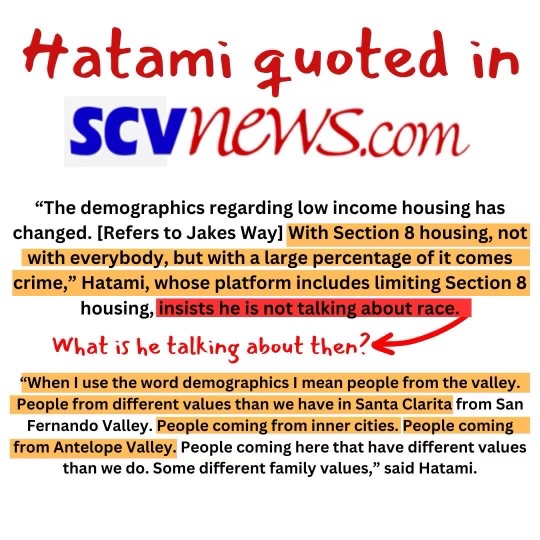
Regardless of how one feels about Hatami’s policy positions, voters should ask themselves, and Hatami himself, whether someone who has expressed these opinions and held these values, even while flip-flopping repeatedly to fit the political winds, is fit to dispense justice in a majority non-white county fairly and without bias.
3. A good man who is not right for the role: Nathan Hochman
By all accounts, Nathan Hochman is a fundamentally decent man. He is intelligent and diligent. He has a record of public service as a federal prosecutor and as President of the Los Angeles City Ethics Commission. He is, however, not qualified for the position he seeks. As noted with Jeff Chemerinsky, the crises within the D.A.’s Office leave no room for on-the-job training. Being a federal prosecutor does not prepare one to be District Attorney, any more than being an excellent brain surgeon prepares one to be a heart surgeon. He has the fundamentals, but would face a steep learning curve in the office. L.A. does not have that kind of time right now.
Moreover, when he ran for state Attorney General he performed worse in Los Angeles County even than in uber-liberal San Francisco. He was not able to resonate with L.A. voters. There is a sense that he views the D.A. position as a sort of consolation prize — which, of course, it is not. In the current race, despite outraising other candidates by a substantial margin, his advertising and ground game haven’t moved the needle nor engaged voters. And while he and Hatami are personally very different, Gascón would use the same relentless messaging against the erstwhile Republican Hochman.
In short, he is a good man who is not right for the job.
4. Not ready for prime time: Debra Archuleta, Craig Mitchell, Maria Ramirez
The final tier of the race includes Superior Court judges Debra Archuleta and Craig Mitchell, and Deputy District Attorney Maria Ramirez. All are experienced lawyers and public servants. Archuleta and Mitchell have proven they can win elections, and both seem to be in the race for the right reasons. In particular, Mitchell deserves enormous credit for founding and sustaining the Skid Row Running Club. Archuleta has been dogged on the campaign trail, and at debates is often the most impassioned speaker. She has gotten in Gascon’s face in debates, and she gives as good as she gets. In a race that otherwise has felt downright docile at times, considering the stakes, that counts for something. Indeed, it counts for a lot.
Neither Archuleta nor Mitchell, however, has recent experience in the D.A.’s Office. As with Hochman and Chemerinsky, they would have a steep learning curve at a time when Los Angeles needs Day One preparedness. Again, this is not the time to ask Los Angeles County voters to take a leap of faith. Moreover, with a shortage of experienced judges on the Superior Court bench, they can do more for the County in their current positions. Los Angeles County residents are lucky to have them. For her part, Ramirez has failed to distinguish herself from the pack, lagging in both fundraising and endorsements.
John McKinney: The best choice for treacherous times
All of which brings us back to the consensus candidate, John McKinney. His intellect, experience, and life story place him head and shoulders above the field. Born into poverty during the gang and crack epidemics of the 1980s and 1990s, he put himself through college working as a welder, fast food worker, carpenter’s apprentice, and house painter. He knows what it’s like to be tempted by the quick money, easy glory allure of criminal life. Against all odds he rose above, eventually attending one of the top law schools in the country, UCLA. For 25 years he has put those lessons and experiences to work protecting the people of Los Angeles.

Equally importantly, maybe more importantly, John is one of the most fundamentally decent human beings you will ever meet. He laughs easily, and it’s contagious. He passes the political litmus test of “would you want to have a beer with this guy” with flying colors. When it comes to the job, he is clinical, incisive, and relentless. And, it cannot be said enough, his own colleagues want him to be their next boss, by a 4-1 margin.
A final thought: On Saturday I had the honor of walking with John in the L.A. Chinese New Year Parade. Hundreds of thousands of people turned out from around L.A. County. As I followed him in the Mustang convertible in which he was riding, I saw the excitement, the enthusiasm, on the faces of the crowd. Several business owners had hung McKinney signs in their windows for the occasion. People came running out to the car just to shake his hand.
A campaign cannot conjure that kind of magic. It’s the candidate. I have seen John at work, I have seen him in campaign mode, and I have broken bread with him. He is, far and away, the best candidate to defeat George Gascon and restore safety and sanity to Los Angeles County.
We do not have a moment to lose.
 the all aspect report