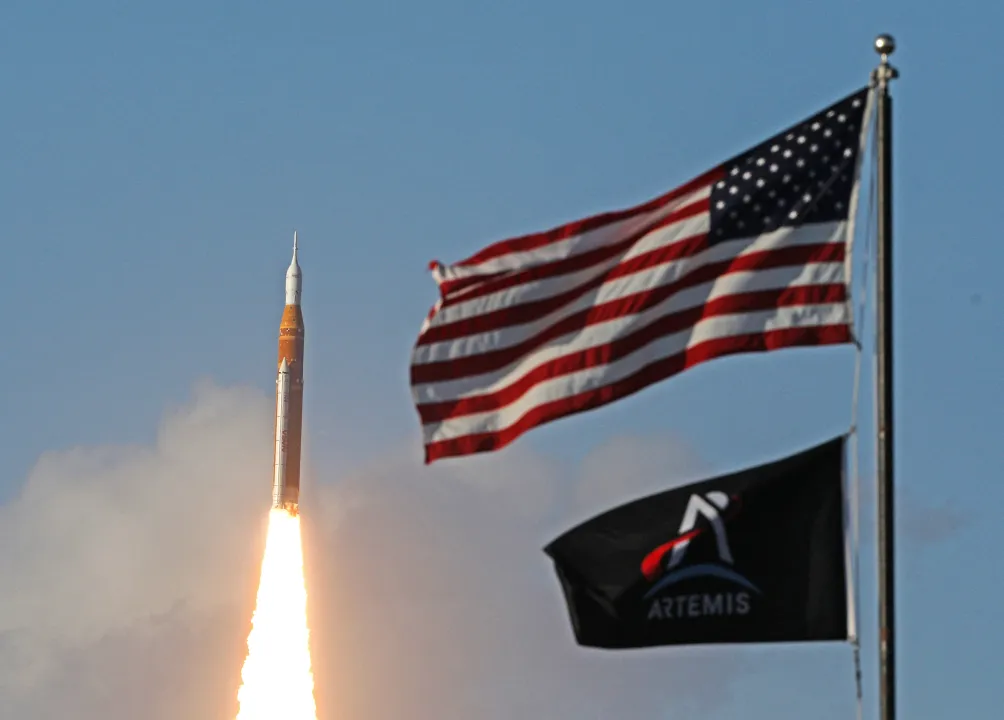
Artemis II lifts off from the Kennedy Space Center. Photo Courtesy News Nation.
As I type these words, four American astronauts are en route to the Moon. Artemis II blasted off from Kennedy Space Center at 6:35 EDT yesterday evening. It’s the first crewed mission to the Moon in nearly 55 years, since Apollo 17 in December 1972. For perspective, more than three-quarters of Americans weren’t alive the last time we attempted a Moon mission.
I say “we” intentionally. Artemis II is the kind of moment that obliterates lines of race, class, orientation, national origin and all the other inherent human characteristics politicians use to otherwise try to divide us these days. It’s a moment that inspires genuine awe, an emotion that’s in short supply these days. How many thousands, or millions of children watched the launch on TV and decided, as the engines roared to life and the massive rocket arced skyward, to become scientists, engineers, pilots or even astronauts themselves (if the mission is any indication, that career field will be in demand in the coming decades)?
While Artemis II won’t land on the surface, it will do something unprecedented by completing a loop to the far side of the Moon for the first time in history. In so doing, the astronauts will travel farther from Earth than any human beings ever have. They also reportedly will skim as close to 6,000 feet from the lunar surface.
People who watched the launch in person described feeling the Earth beneath their feet shake. While Artemis II’s rocket (technically called the Space Launch System) isn’t quite as tall as the Saturn rockets that propelled the Apollo astronauts into space, it produces about 20% more thrust, making it the most powerful in history.
A rare, needed moment of unity
I confess: I got a little misty when the final countdown commenced. I thought back to the day in elementary school when the teachers wheeled a TV into the classroom so we could watch the first Space Shuttle launch. I thought of the nights spent in our backyard looking through my father’s little Celestron telescope, which made planets and nebulae just big enough to see in all their glory. I remembered going out to the desert to a “star party,” where scores of amateur and professional astronomers had hauled their telescopes, and gazing at Halley’s Comet, and how my school chum Paul and I promised to meet in 76 years to see it again.
I thought of my own first flying lesson, at the tender age of 15.
I also thought of a more recent memory, when the Space Shuttle Endeavor arrived above L.A. attached to its Boeing 747 transport, flanked by F/A-18 fighter jets and T-28 Talon jet trainers. I remembered how tens of thousands of people gathered along the Santa Monica bluffs for its arrival, lining the bluffs themselves, the beach, the Santa Monica Pier, rooftops, even parking garages.
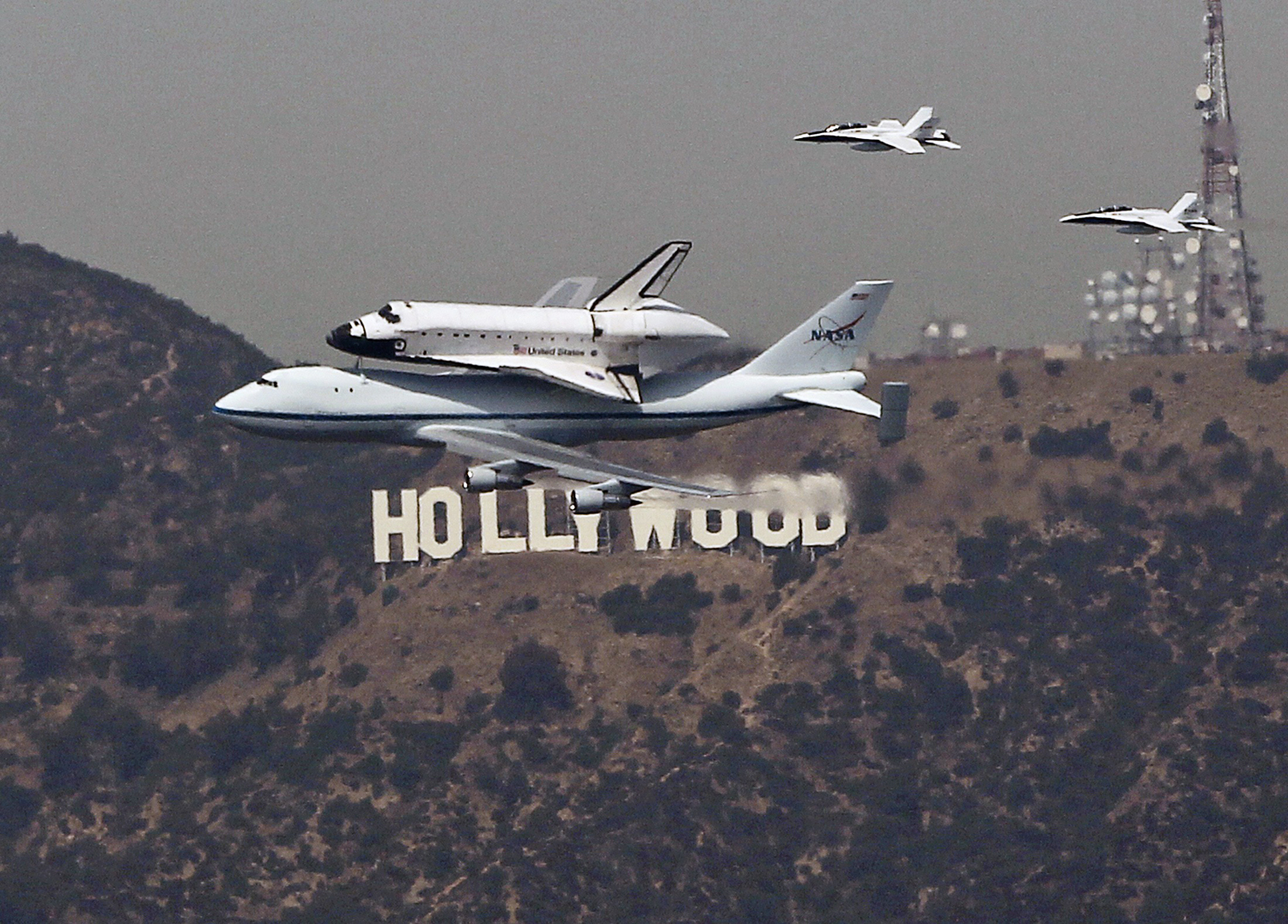
The Space Shuttle Endeavor arrives in L.A. NASA photo.
In a way, that’s the most immediately relevant memory. Because as unifying as that day was — and the subsequent days as the craft made its way along L.A. streets to its final home at the Los Angeles Science Museum — it was bittersweet. A Space Shuttle would never take the heavens again. Endeavor was headed for a permanent static display, albeit a spectacular one. Still, in some ways, locking a Space Shuttle inside a museum feels like an entombment. A craft that had, as WWII British pilot and poet John Gillespie MaGee Jr. wrote, “trod / The high untrespassed sanctity of space / Put out [its] hand, and touched the face of God,” would never move again. It was a reminder that nothing lasts for ever, not even humankind’s most stunning achievements.
It also came at the nadir of the United States’s once mighty space program. NASA remained plagued by the problems and loss of confidence that took hold in the wake of the Challenger and Columbia disasters. The best and the brightest no longer dreamed of working at Cape Kennedy, Vandenberg, Edwards or Moffet. They were going to work for SpaceX, Blue Origin and the short-lived Virgin Galactic. What had once been the world of square jawed generals, dashing test pilots and protractor wielding geniuses — yes, it was an extremely male world — became the playground of billionaires. Those companies accomplished remarkable things, but they were transactional. They lacked the unifying grandeur and the magic of Gemini, Apollo and the Space Shuttle. We’d gone from Buzz Aldrin and Neil Armstrong to Katie Perry and Lauren Sanchez Bezos.
While the agency is not without its share of challenges, it turns out that the stories of NASA’s total demise were exaggerated. With Artemis II, it feels like we can look up at the night sky and dream again. And dream together.
One man told the New York Times that he’d driven eight hours from South Carolina to witness the launch. Rajan Gianey said, “I drove eight hours … to be here with all of you. It’s such a beautiful event, and this event can bring this beautiful country together.”
Unity was a recurring theme in the interviews.
Cosmic coincidence?
I went outside last night and noticed it was a full moon. I don’t know if Artemis II’s engineers and leadership planned the launch to coincide with it. I actually hope they didn’t. I hope it was just a beautiful cosmic coincidence: A vessel that’s the space travel equivalent of a fragile sailing ship exploring the seas during the Age of Exploration starting some 650 years ago is taking humankind’s collective next tentative step into the cosmos, and the cosmos gave the rest of us back down on Earth something beautiful, a bright, glowing orb of recognition.
It’s even more fitting: This month’s full moon is a Pink Moon, so named for the spring flowers that start blooming this time of year. Symbols of renewal, new beginnings, new hopes.
So take a few minutes over the next 10 days to check in with Artemis II’s progress. Take a few minutes to gaze up at the night sky and wonder, to feel like a kid again.
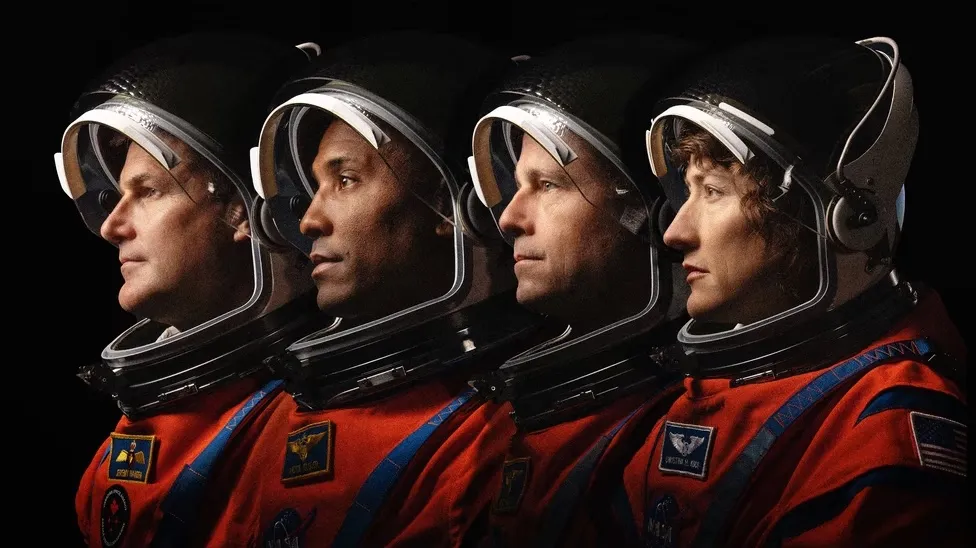
Artemis II’s crew. NASA photo.
Meantime, godspeed to the crew: Commander Reid Wiseman, Pilot Victor Glover and Mission Specialists Christina Hammock Koch and Jeremey Hanson. May your vessel be sturdy, may your course be true, and may you return home safely and with magnificent stories to share.
HIGH FLIGHT
John Gillespie MaGee, Jr.

Oh! I have slipped the surly bonds of Earth
And danced the skies on laughter-silvered wings;
Sunward I've climbed, and joined the tumbling mirth
of sun-split clouds,—and done a hundred things
You have not dreamed of—wheeled and soared and swung
High in the sunlit silence. Hov'ring there,
I've chased the shouting wind along, and flung
My eager craft through footless halls of air ....

Up, up the long, delirious, burning blue
I've topped the wind-swept heights with easy grace
Where never lark, or even eagle flew—
And, while with silent lifting mind I've trod
The high untrespassed sanctity of space,
Put out my hand, and touched the face of God.

 the all aspect report