

Sacramento’s message to Californians: “Burn, baby, burn.”
The winds are calm. As an unusual late winter heat wave sends temperatures in the Southland into the 90s and breaks records, that’s what I keep telling myself. The peak Santa Ana winds season is over. Fire season is over. The fires being unleashed by the United States and Israel in Iran are 8,000 miles away.
Yet as I type these words on this hot, stale Saturday, I feel something in my bones. It’s not just the warm air; it’s the dryness. We had a historically wet winter, with some parts of Southern California recording the most rainfall since 1979. We got enough rain to trigger superblooms in the mountains. Those hundreds of square miles already are starting to dry out.
It’s a repeat of 2024-25, when a series of atmospheric rivers deluged the region, followed by a warm, dry spring, summer, and autumn. While it’s obviously too soon to tell what 2026 will bring, it feels all too familiar.
Nor is it merely a meteorological curiosity. Sacramento is in the midst of a historic push to force cities throughout California to add millions of units of new housing. This push, which ironically began simultaneously with the state’s entry into a new era of wildfire risk in 2016-2017, completely ignores realities on the ground. Unscrupulous developers already are taking advantage of a raft of new laws Sacramento has enacted to build dense housing where it’s completely inappropriate, and even dangerous.
This weekend’s weather is just the latest reminder that too many state lawmakers are prioritizing developer profits over the safety of 40 million Californians.
Consider: In the wake of historically devastating wildfires in 2017 (the Tubbs Fire in Sonoma destroyed 5,643 structures and killed at least 22 people; the Thomas Fire in Ventura and Santa Barbara Counties burned nearly 450 square miles) and 2018 (the Camp Fire obliterated the Butte county towns of Paradise, Magalia, and Upper Ridge and killed at least 88 people; the Mendocino Complex Fire burned 720 square miles; and the Woolsey Fire became the biggest in the recorded history of Los Angeles County).
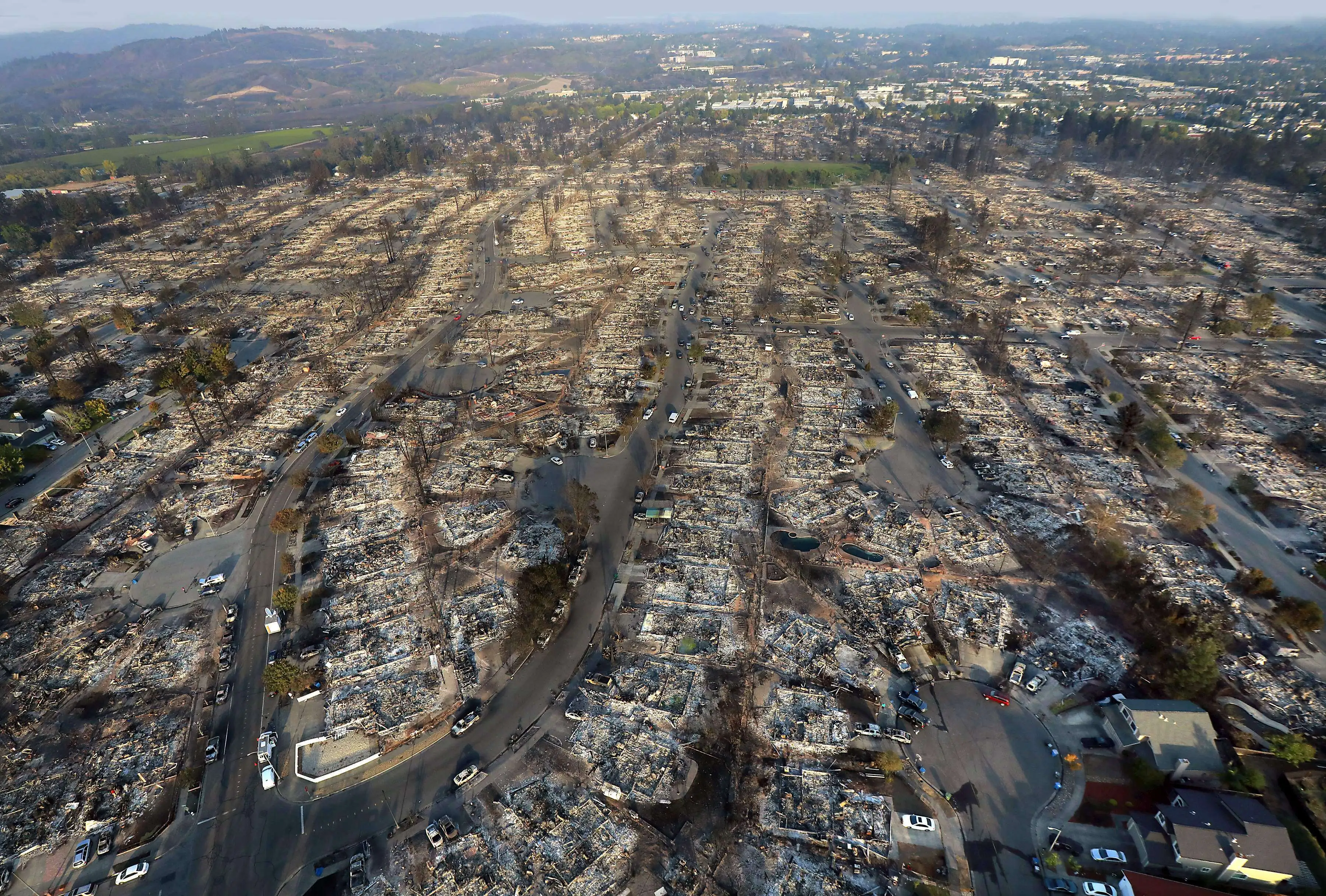
The 2017 Tubbs Fire all but wiped the Coffey Park neighborhood in Santa Rosa off the face of the Earth. Photo courtesy of the Sonoma Press-Democrat.
All told, in those two fire years at least 152 people lost their lives, 500 were injured and some 33,295 homes, businesses and other structures were destroyed.
The total number of deaths directly and indirectly attributable to those fires will never be known, but it is assuredly in the tens of thousands. A paper published two weeks ago in the journal Science Advances estimates that wildfire smoke kills an average of 24,100 people in the contiguous 48 states every year. For the mathematically inclined, that’s nearly a quarter of a million people in the modern wildfire era that began in 2016.
Even that is likely a significant underestimate, as it can take years or decades for people exposed to wildfire smoke, particularly the toxin-laden soot and ash from buildings, vehicles and equipment burning in populated areas, to manifest symptoms and consequences.
This is the environment, the reality, into which Sacramento lawmakers are attempting to force those millions of new homes. They are whistling past the graves of those tens of thousands of dead, and tens of thousands more who will die in the future. Their indifference, callousness and cold-heartedness is staggering. It’s possible only among those whose lives are utterly insulated from reality and consequences.
Never forget, these are the same lawmakers who passed a bill that makes it all but impossible for law enforcement to rescue women and young girls — many of them underage — who are trafficked and sold for sex in broad daylight in places like South L.A.’s Figueroa Corridor (some, but not all, of the worst parts of that 2022 law, perversely called the “Safer Streets for All Act,” were rolled back as of January 1 of this year).
If Sacramento politicians don’t care about 12 year old girls being trafficked, abused and raped for profit, is it any surprise they don’t care about the wildfire risks faced by millions of homeowners and residents?
In the wake of the 2017 and 2018 wildfire seasons, the legislature actually passed a good law. As of January 1, 2022, AB 747 requires every city in the state to identify evacuation routes, and evaluate their capacity under a range of emergency scenarios.
Unfortunately, even when Sacramento lawmakers get something right, they still manage to screw it up. AB 747 is one of the most poorly written bills you’ll ever see. It contains no funding, no standards or guidelines for how cities should conduct the required evaluations and no timeframe for them to be completed. Worst of all, it contains no penalties or consequences for cities that fail to fulfill their obligations. As a consequence, the vast majority of cities are noncompliant.
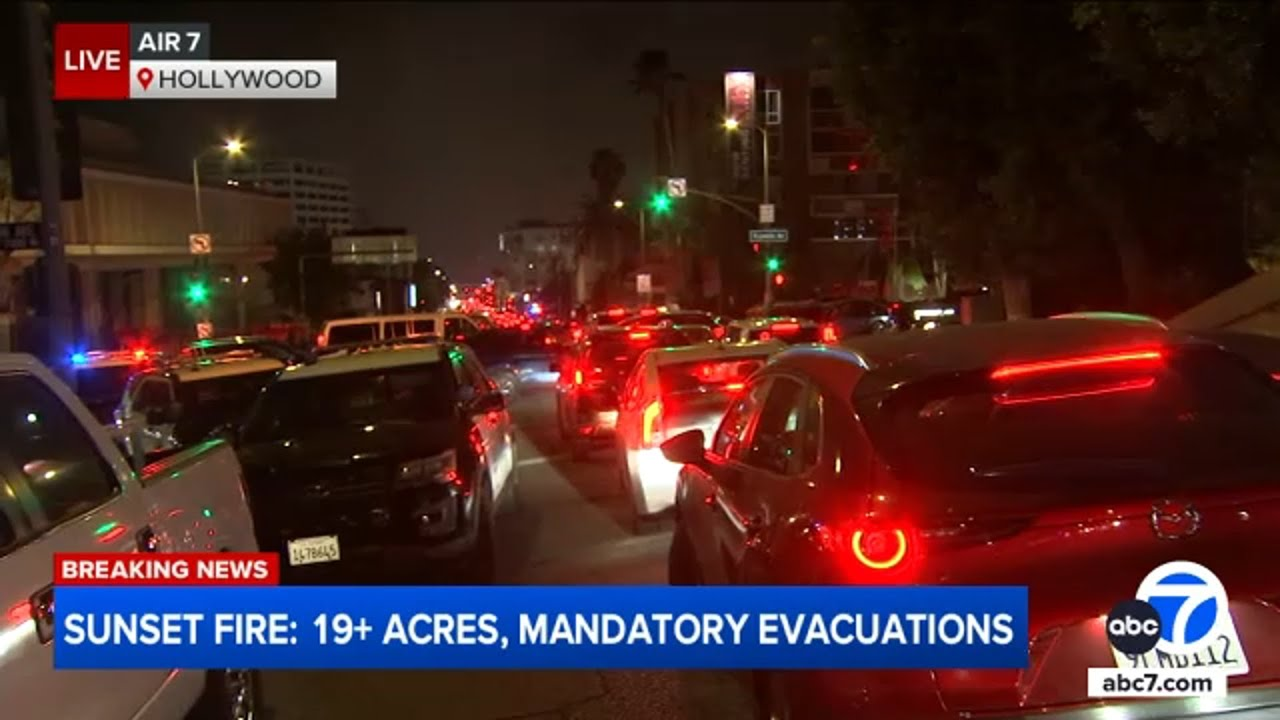
As much as Sacramento politicians and their real estate industry “YIMBY” taskmasters like to harp on suburbs and single family communities, evacuation gridlock isn’t unique to those areas. During the January 2025 Sunset Fire in Hollywood’s Runyon Canyon — which ignited while the Palisades and Eaton Fires still raged — evacuations likewise gridlocked. People reported being trapped in their building’s garages for hours.
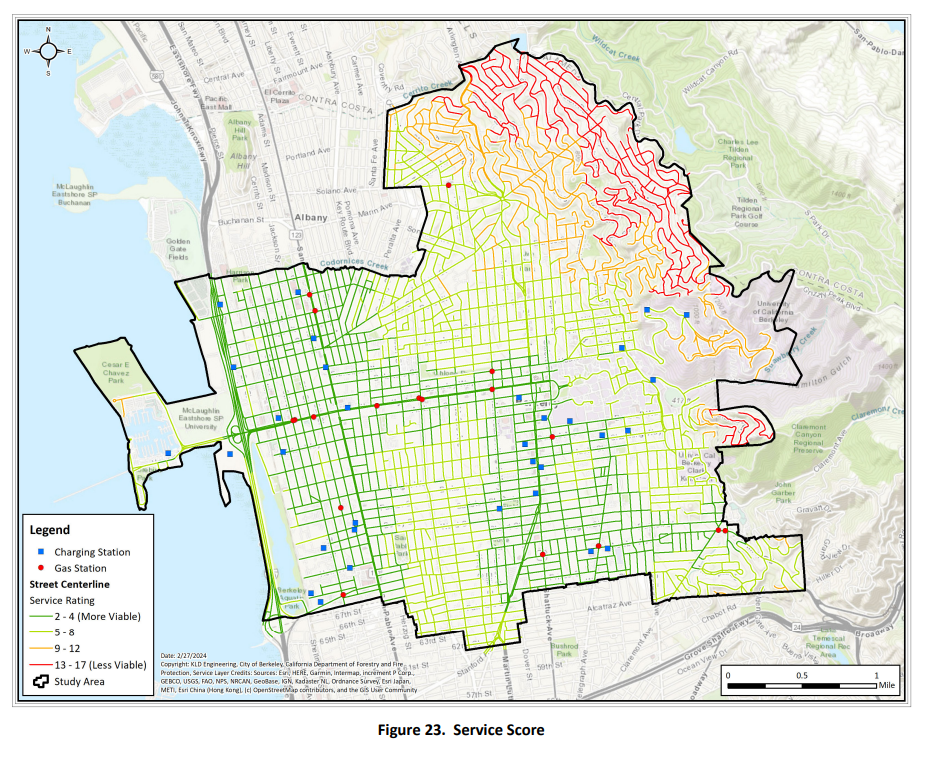
That said, the few cities that have performed the evaluations offer a sense of how dire things are. Consider the two maps below, of Berkeley. The first shows the level of service (“LOS”) on the city’s streets on a normal day. The second shows estimated LOS during even a “minimum demand” evacuation scenario. It’s chilling. And Berkeley is adjacent to a major freeway network. Imagine what similar maps would look like in cities and communities far from freeways and major thoroughfares.
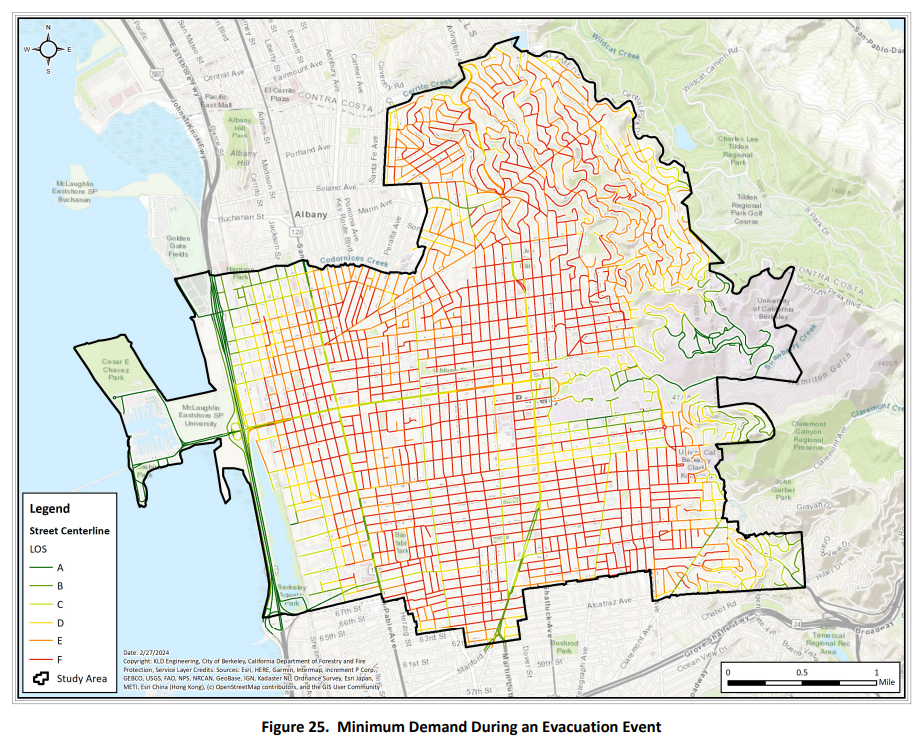
The scope of the political class’s recklessness is impossible to overstate. In the name of real estate developer and investor class profits, they’re playing Russian roulette with millions of lives. This is not abstract, nor is it conspiracy mongering. Revisit the numbers earlier in this post — the lives lost, the homes destroyed, the land scorched. Then add in tens of thousands new homes and tens or hundreds of thousands of new residents into those same areas. Consider that, even as the Palisades Fire was burning, even as people were losing their homes and their lives, state senator Scott Wiener (D–San Francisco, because of course) introduced a bill that would have made it easier for developers to build multifamily buildings in single family neighborhoods in that community.
Consider, lastly, that the political class is doing this to Pacific Palisades, home to some of the state’s wealthiest and most influential people. If they can do it there, what chance does your neighborhood have?

 the all aspect report