With each official report, we get further from answering the most important questions about January 7, 2025
[Update 11/23/2025: I have submitted public records requests under the California Public Records Act seeking information from LADWP, LAPD, LAFD and other agencies related to the issues raised in this post. Stay tuned to the all aspect report for further updates.]
It’s the Friday before Thanksgiving week, so that means California officials have dropped consequential news to which they don’t want anyone to pay much attention.
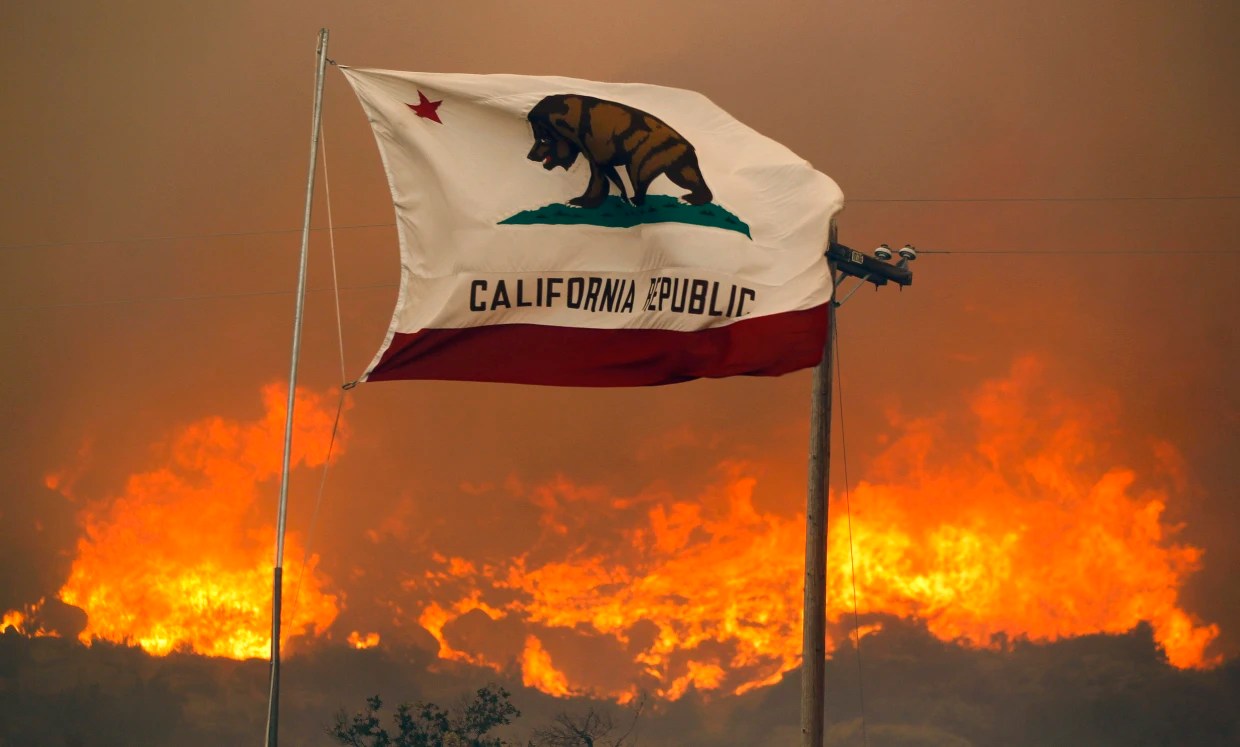
Nearly 11 months after the Palisades Fire that destroyed more than 7,000 homes, killed 12 people, displaced some 25,000 and destroyed scores of beloved small businesses, survivors — and all Angelenos — still have more questions than answers.
Today, as part of their ongoing efforts to not answer those questions, a hydra of state agencies released a report on the failure of the community’s high pressure water system and fire hydrants to provide adequate — and in many places, any — water to fight the fire. The report focused in particular on the fact that the 117 million gallon Santa Ynez Reservoir was empty, and the potential implications. Spoiler: They didn’t really find any.
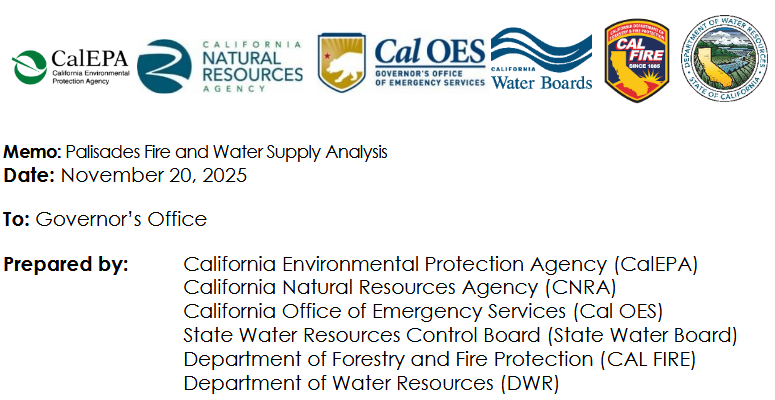
After 10 months of review involving Lord only knows how many bureaucrats, the agencies reached the following conclusions: 1) The Palisades water system is “robust,” 2) it didn’t really matter that the Santa Ynez Reservoir was empty, because the system’s structure inherently limits water delivery, and, most importantly, 3) nothing to see here folks, please move along.
You’ll note that conclusions 1 and 2 directly contradict each other. A water system that is inherently limited is not “robust.” It is the opposite: Inadequate. The report also concludes that the system’s primary purpose is to provide drinking water, which the authors (whoever they are) helpfully note, “limits the types of engineering considerations that would likely be needed for a water system capable of combating large conflagrations engulfing hundreds of structures such as the one in Palisades.”
Likely be needed? The wording suggests that officials at multiple state agencies responsible for the state’s drinking and firefighting water supplies don’t fully know what types of engineering are necessary for the latter. They’re just kind of guessing. That’s shocking.
Santa Ynez Reservoir was partly intended for firefighting
Contemporaneous reporting during the reservoir’s construction rebuts the report’s conclusions. A July 7, 1966 story in the Los Angeles Times specifically noted, “Los Angeles Department of Water and Power engineers said the reservoir is needed to provide additional water storage for domestic use and firefighting purposes in the area west of Rustic Canyon along Sunset Boulevard and on the south slope of the Santa Monica Mountains,” aka Pacific Palisades (emphasis mine).
Another Times story on July 28, 1966 repeated the assertion. Still another, from UPI on November 6, 1970, reported that the Los Angeles Department of Water and Power (LADWP) had filled its 100th reservoir, Santa Ynez, “for domestic use and fire protection.” Likewise, contemporaneous documents related to the reservoir’s construction refer to firefighting capability. In particular, the project’s final construction report — which conveniently has been removed from LADWP’s website — cited the reservoir’s intended service as a water source for firefighting.
Apparently state and local water engineers knew “the types of engineering considerations” needed for a “robust” firefighting system in the Palisades as it waas 60 years ago. Too bad that knowledge wasn’t passed along to the current generation.

Santa Ynez Reservoir under construction, February 1967. LADWP archive photo.
As an aside, the report gives a sense of how hopelessly inefficient LADWP is. The Environmental Protection Agency (EPA) issued regulations in the late 1980s requiring reservoirs that provide drinking water to be covered to prevent contamination. The report notes, “LADWP adopted a plan to cover the reservoir in 1989, initiated the cover in early 2000s, and completed installation in 2012.” In other words, it took the agency 23 years to install the federally required cover on a single, small reservoir. Let that sink in a moment (no pun intended). Is it any wonder they were caught completely flat-footed and unprepared for a historic fire?
Full CYA mode
On page 7 of the report the ass-covering kicks into overdrive. The authors conclude that a full reservoir may have added as much as 15% more water flow to the Palisades system. Here’s the money shot: “The state does not have data regarding the precise demand on the system [during the fire] at this time. Without additional data and a modeling effort by LADWP, it is not clear exactly how much time the 15 percent extra flow would have extended water availability.”
Translation: Even though we are the state’s leading experts on water storage and delivery, golly we just don’t really know how much a full reservoir would have helped.
You don’t need to be an expert to conclude that any additional water would have helped. An event like the Palisades Fire pushes human beings, equipment and supplies to their absolute limits. In that context, 15% is a huge number. Yet the report’s authors saunter past that fact without so much as a sideways glance.
The bulk of the report is surplusage, a word salad of rehashed, irrelevant narrative and excuses.
Today’s drop comes on the heels of LAFD and LACOFD after action reports. Oddly, six weeks after its release LAFD’s report has been removed from their website, as has a fact sheet related to it. The County’s report is limited to evaluations of pre-fire planning, emergency notifications and evacuations.
To be sure, there’s probably no water system in the world that can deliver the full volume needed to fight a conflagration like the Palisades Fire. Firefighters also confronted an unprecedented situation in which at least a dozen major fires ignited within 24 hours during one of the most powerful Santa Ana events in recent history, stretching resources beyond the breaking point. As officials dithered — and as Mayor Karen Bass was off on a literal ego trip overseas — the rank and file performed heroically under the circumstances and given what they had to work with.
Many reports leave many unanswered questions
Yet all of that misses the crucial point. The point is that all the official reports, analyses, after action reports and so on continue to shade the details. For example, we still don’t know — despite multiple public records requests from multiple outlets and journalists, including myself — why it took the first crews nearly 20 minutes to reach the Palisades Fire ignition point near Skull Rock in the Palisades Highlands. LAFD Station 23 is literally five minutes down the road, at the corner of Sunset and Los Liones. In its early stages a wind driven wildfire doubles in size roughly every one to four minutes. What if the firefighters had arrived ten minutes sooner? Likewise, we still don’t know why LAFD leadership up to and including former Chief Kristin Crowley failed to predeploy resources in the Palisades.

By midnight on January 10, virtually all of west Los Angeles County was threatened by wildfires.
We still don’t know how many arsonists were at work. We don’t know the fate of Gloria Lynn Mandich, who was arrested for starting a fire in Leo Carrillo State Park on the morning of January 8, barely 24 hours after the Palisades Fire ignited. Had that fire taken off it could have merged with the Palisades Fire, enveloping virtually the entirety of the Santa Monica Mountains, along with the cities of Calabasas, Agoura Hills and Thousand Oaks. Thousands more homes might have burned, many of them in areas that are exceedingly difficult to evacuate. Along with the Kenneth Fire in West Hills, two brushfires in Sylmar, one of which became the Hurst Fire, the Lidia Fire near Sunland Tujunga and two fires in the Balboa Basin – all of which ignited in the first 24 hours – the entirety of west Los Angeles County was imperiled.
What about Juan Manuel Sierra, an illegal immigrant on felony probation who was arrested by LAPD on January 10 for attempting to light fires with a blowtorch in the vicinity of the Kenneth Fire and was declared a “person of interest” in that blaze? Initial reports were contradictory, and we’ve heard nothing since.
Likewise, we don’t know the fates of Dustin Lee Nehl and Jennifer Nehl, a couple from Oregon who were arrested for impersonating firefighters when they drove a fire truck they’d bought at auction into the Palisades. Fun fact: Dustin Lee is a convicted arsonist. We don’t know the fates of other people arrested for arson in January overall. And so forth.
I have submitted public records requests related to these cases. Stay tuned to the all aspect report for more.
As time goes by, memories fade and details grow increasingly hazy. We may never be able to find out the full extent of the failures that contributed to the carnage in Pacific Palisades and Altadena in January 2025. But it sure would be nice if someone tried.
Like what you’re reading? Please consider supporting independent journalism with a one-time or ongoing contribution to the all aspect report.
Make a monthly donation
Make a yearly donation
Choose an amount
Or enter a custom amount
Thank you! Contributions securely processed via Stripe.
Your contribution is appreciated.
Your contribution is appreciated.
DonateDonate monthlyDonate yearly
 the all aspect report
The answers to your questions are already known, but it is good that you are asking them again. The long story short is that since Garcetti became CD 13 councilmember in 2001, Manhattanization was the agenda and spending money on needed infrastructure inferred with that goal. In fact, even discussion of infrastructure was unwanted. As the LAFD rank and file among others such as HELP and HUNC said back in 2012 and the civil grand jury agreed in June 2013, the city was cutting needed funds from the LAFD (as well as DWP). We knew since the Nov 8, 1961 Bel Air fires that the entire system was inadequate, but developers and Wall Street had other schemes to loot Angelenos. Nothing has changed. Any city official who tells the truth faces the same fate as former fire chief Crowley
LikeLiked by 1 person