Residents are right to worry about planned transit station at Gladstone’s


The new Gladstone’s looks gorgeous. Unfortunately, that’s where the good news ends.
Here we go again.
Last week an eagle-eyed resident in the Pacific Palisades alerted the community to a planned bus station at the intersection of Sunset Boulevard and Pacific Coast Highway. The county is proposing a new bus terminus next door to Gladstone’s Restaurant, or as some of us L.A. natives still call it, Gladstone’s for Fish. The project includes a new bus roundabout that will serve three lines — to start — as well as an expanded bicycle trail along the beach, a dedicated zone where bicycle riders can board buses and rest stops for bus drivers. It’s part of a complete overhaul of the property that will be centered around a brand new, expanded restaurant building designed by Frank Ghery.
The proposal dates to 2018, when Los Angeles County awarded a 40 year lease on the property to restaurateur Wolfgang Puck through an LLC called PCH Beach Associates. Puck hired Gehry to design a modern new restaurant that will be about 30% larger than the existing structure. There was a minor outcry when he announced plans to name the new restaurant Wolfgang Puck’s, and he subsequently promised to keep the famous name.
The good news: Renderings of the new restaurant reveal an attractive, sweeping modernist structure that from certain perspectives resembles, appropriately, a giant fish. There’s an expansive patio with ocean views and outdoor seating. So far, seemingly, so good: A beloved but long in the tooth institution reimagined and recreated by one of L.A.’s most legendary chefs and a revered local architect. I for one can’t wait to experience what Puck has in store.
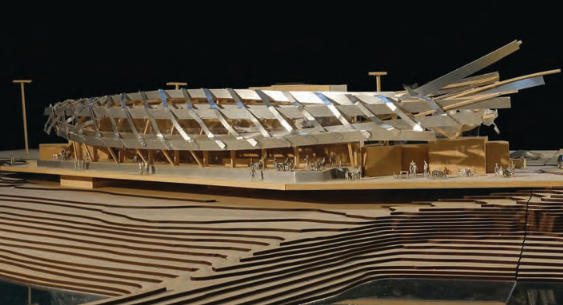
One peculiar thing about Gehry’s design is that it seems it will only look like a fish from a good distance out to sea, as this model shows. Is his goal to taunt the local sea bass? “My buddy Wolfgang’s cookin’ up your cousins in here!”
The idea of expanded bus service to the location, and expanded bus service in the Palisades, isn’t bad on paper. PCH often becomes a gridlocked nightmare on summer afternoons, particularly weekends. Giving people alternatives to their cars makes sense — again, on paper.
There are plans, and then there’s reality. The new bus station, should it become a reality, will do virtually nothing other than eliminating a few badly needed parking spaces for restaurant patrons and beachgoers. That good idea on paper runs headlong into the fact that mass transit in L.A. is a failed system that requires a complete restructuring — not a fancy new bus stop at the beach. Nevertheless, many state lawmakers and more than a few city and county officials — including Supervisor Lindsey Horvath, whose district includes the Palisades — insist on anchoring new development to that failure. As we’ll see, their plans for the Palisades could not possibly be worse.
Worries about a Palisades real estate gold rush
Even before firefighters extinguished the last embers of the devastating January 2025 L.A. wildfires, residents in the Palisades as well as Altadena worried about what rebuilding might look like. A spate of recent state legislation, culminating last week with Governor Gavin Newsom’s signature on Senate Bill 79 (SB 79) have opened wide swathes of the state to overdevelopment, including — or perhaps especially — single family neighborhoods. The planning theory de jure centers on dense, downtown-like apartment buildings where residents rely on public transit, bicycles and their own two feet to get around.
It’s a concept that evolved in small European cities like Amsterdam superimposed on the largest county in the United States. The entire city of Amsterdam, including its suburbs, is just over 80 square miles. L.A. County is 4,083 square miles. To believe that public transit and bicycles can interconnect that vast expanse and the nearly 10 million people who live in it isn’t just delusional, it requires magical thinking that borders on the insane.
Actually, scratch that. It is insane. I’ve explained why, in detail, several times.
The new bus terminus at the Gladstone’s project is the linchpin in planned expanded bus service in the Palisades. Big Blue Bus number 9 and Metro number 102 both currently end a mile up Sunset at Marquez Place. Both would be extended to the new terminus. Both transit agencies also plan to increase service frequency — which is where the real trouble starts.
SB 79 allows developers to build up to 15 story apartment buildings within a quarter mile of certain transit stops and 10 stories within a half mile, including in neighborhoods zoned for single family homes and/or small multifamily homes like duplexes, fourplexes and small apartment buildings. Cities aren’t allowed to so much as review the plans.
The law — which takes effect in June 2026 — has three requirements: 1) two intersecting bus lines that 2) run along dedicated bus only lanes for some part of their routes with 3) and buses that run every 15 minutes during morning and evening commute times. That’s it. The dedicated lanes can be as short as a block or two out of an entire line.
Neither Big Blue Bus 9 nor Metro 102 currently qualify, but don’t get too comfortable. The former already has dedicated lanes along three blocks past SAMO High School, and plans call for it to increase to a 15 minute headway. The latter likewise is planned to get them where it runs past UCLA. Additionally, in the March 2024 primary elections L.A. city voters — persuaded by a slick, misleading $3 million campaign — approved Measure HLA. That new law requires the city to add dedicated bus or bicycle lanes whenever it repaves or rehabilitates a section of street longer than 880 feet, basically a city block.
In short, SB 79 transit is barreling toward L.A. like Keanu Reeves’s bus in Speed. And if you don’t think some of the biggest, most powerful developers in the world and their financial benefactors aren’t salivating over the prospect of turning swaths of Pacific Palisades into a mini Miami Beach, I’ve got a bullet train in Fresno to sell you. Nor will Altadena be spared — imagine a mini Manhattan at the base of the San Gabriel Mountains.
Even if SB 79 were somehow a good idea, even if it was a good idea to transform two of L.A.’s most historic and beloved communities into just a couple more soulless modern urban cores, it will never work.

Here comes SB 79….
L.A. transit is a train wreck
Public transit service in L.A. is absurd if not downright on Khafkaesque. Transit maps appear to have been drawn by M.C. Escher. Let’s consider a real life example. Gladstone’s is 4.5 miles from my front door here in Santa Monica. Say a friend and I are feeling spontaneous and decide to meet there for brunch this morning. By car it’s a 15 minute drive, door to door. It requires me to travel half a mile to the California Incline and jump on PCH. It’s 10:30am as I type these words. By the time I pull on my shoes, give the dog a treat, get in the car and hit the road, I’m walking in the restaurant’s front door by ten to 10:00 at the latest.
Here’s how it will go if I take temporary leave of my senses and decide to use transit: First, I’ll have to walk half a mile to the bus stop, which will take 10 to 15 minutes, or nearly as long as the entire trip by car. Adding to the hilarity, I’ll be walking in the opposite direction from the restaurant, meaning I’d catch the bus half a mile farther away from it than where I started. I’d catch the Santa Monica Big Blue Bus number 2, and ride it five stops to the corner of Fourth Street and Santa Monica Boulevard, which Google Maps says takes just five minutes. Color me dubious. From there, it’s a one and a half block walk to catch L.A. Metro number 134, which I’d ride for 15 minutes and make five additional stops. Upon arrival I’d walk another block and cross PCH, which is always an entertaining experience. Finally, I’d walk into the restaurant, gazing enviously at normal people handing their car keys to the valet attendants.
Let’s review. In what allegedly remains a first world city and county, a 4.5 mile trip on public transit, one that takes barely 15 minutes by car, requires half a mile of walking in the wrong direction, four legs, and a transfer, for a total of 45 minutes. For the mathematically inclined, that works out to 6mph. And that’s assuming both buses are on schedule and I nail the transfer. Best of luck with that. It’s likely, in fact almost certain, that it would take a full hour, meaning I’d be traveling at 5mph. A healthy human being walking at a brisk pace can cover five miles in an hour.
The results are equally absurd everywhere you look. Say a family of tourists plan to spend the afternoon at The Getty Center in Brentwood before heading to Abbot Kinney, where they have dinner reservations at The Butcher’s Daughter. In a rental car, it’s a 25 to 30 minute drive. Let’s add 10 minutes while they circle for parking.

Now, let’s assume that family is from one of the many countries in the world — including more than a few developing countries with gross domestic products smaller than that of a medium sized American fast food chain — with robust, rational, efficient, well-managed transit systems. As they made their travel plans they made the grievous error of assuming that L.A., which they unfortunately have been led to believe remains a first world city and county, must be the same.
Most such families will realize their mistake, in the worst possible way, within the first 10 or 15 minutes of their bus journey along the 110 to their downtown hotel. Before so much as checking in, and even if Mom and Dad’s bladders are full to bursting with multiple rounds of tepid airline cocktails, as soon as they get to the hotel (which undoubtedly also will have required a walk) they will dash to the nearest rental car desk and remedy things before the entire vacation is ruined.
Every now and then, though, a family will prove either stubborn or delusional enough to stick with transit, even after encountering a raging lunatic vagrant on the bus who attempted to throw one of the children out the widow. They’ll figure it was an anomaly. Could happen anywhere. They will be sadly, sadly mistaken.
Here’s how the trip from the Getty to the restaurant will go on transit: First, they will catch Metro line 761 in front of the museum and ride it 15 minutes and four stops to the intersection of Hilgard Ave. and Westholme St. in Westwood. As with my theoretical odyssey to Gladstone’s, at the end of the first leg they will be farther from their destination than when they started, in this case by a mile and a quarter. Next, they’ll transfer to Metro line 1, which they will ride for 55 minutes, making no fewer than 41 stops. Finally, they will walk a third of a mile to the restaurant. According to Google Maps the trip will take 1hr 18min, at the end of which they will no doubt be in high spirits thanks to the joy that is riding transit in L.A., the stories of which will become part of family lore and handed down to generations. As always, this assumes the buses are on schedule. On the plus side, it’s likely that only one or two of them will have gotten stabbed.
If they’re staying downtown, the transit trips from their hotel to the Getty, the Getty to Abbot Kinney, and Abbot Kinney back to their hotel will collectively require 4 hours and 21 minutes. They will have traveled a total of approximately 45 miles, for an average speed of just over 10mph.
Viewed another way: If our hypothetical family is here for a week, and wants to visit far flung destinations like Disneyland, Hollywood Boulevard, Venice Beach, the Santa Monica Pier, The Getty Center, and so forth, they will spend at least a full day and a half of their trip riding transit. I don’t mean a working day and a half, I mean 36 hours of their lives riding buses hither and yon. Once more, that’s assuming the buses are on time, traffic is light, only a couple of them get stabbed, etc.
So let’s recap: Residents of Pacific Palisades and Santa Monica are supposed to support a large new bus station on the beach, which will devour a third of the current parking spaces for a public beach and what will undoubtedly be a hugely popular new dining destination, even though they know full well it will end up playing a central role in an attempt by billionaires from every corner of the globe to radically reshape their community, and even though they know full well that virtually no one will ever use the buses it serves.
All of that being said, if I haven’t persuaded you that the Gladstone’s bus facility is a terrible idea and a waste of public resources, and if you are still inclined to trust the City and County of Los Angeles on this one, please email me at allaspectreport@gmail.com. I know a Nigerian prince who’s currently selling shares of the Fresno to Merced leg of the California bullet train, and I’d be happy to put you in touch for a reasonable fee.

 the all aspect report
Absolutely positively spot-on. Big money developers and real estate investors, many out of state or foreign, covet the very ground on which our homes sit, and the fire has given them a rare opportunity.
LikeLike
Hello, you are right A FIASCO- the same thing happened back in 1960’s the habitants at MDR and Playa Del Rey and Westchester, complained because the freeway would open the way from all people to come and destroy these areas. Please read this attachment to understand the Woke and drugged ideas of these “politicians” to destroyed a city. https://bloximages.newyork1.vip.townnews.com/westsidecurrent.com/content/tncms/assets/v3/editorial/7/d6/7d65cc08-5779-11ee-941e-6300640633c3/650a8814aab3b.file.pdf
LikeLike
“SB 79 allows developers to build up to 15 story apartment buildings within a quarter mile of certain transit stops and 10 stories within a half mile” This is incorrect.
SB 79 allows for buildings of up to 9 stories directly adjacent to transit stops, 7 stories if they’re within a quarter mile of a stop, or 6 stories if they’re within a half mile of a stop.
“The law — which takes effect in June 2026 — has three requirements: 1) two intersecting bus lines that 2) run along dedicated bus only lanes for some part of their routes with 3) and buses that run every 15 minutes during morning and evening commute times. That’s it. The dedicated lanes can be as short as a block or two out of an entire line.” This is also incorrect.
In order for a bus stop to qualify, the route must include full-time dedicated bus lanes or operation in a separate right-of-way dedicated for public transportation with a frequency of service interval of 15 minutes or less during the morning and afternoon peak commute periods.
LikeLike