With yesterday’s Palisades and Altadena executive order, Newsom revealed the great YIMBY fraud

gemini.google.com
Under pressure from local leaders in Los Angeles, including Councilwoman Traci Park and Mayor Karen Bass, yesterday afternoon Governor Gavin Newsom signed an executive order suspending enforcement of a law called Senate Bill 9, or SB 9, in L.A. wildfire burn zones. It’s a small but important victory for survivors of the January 2025 L.A. firestorms. SB 9, which took effect in 2022, requires cities to approve multifamily developments of up to eight units on existing single family parcels, as long as the developments meet certain requirements. Some observers and experts believe the law could allow as many as 12 units on single family parcels.
Confirming observers’ worst fears about how unscrupulous developers could take advantage of SB 9 and other laws in disaster recovery zones like Pacific Palisades and Altadena, last week it came to light that developers have purchased burned single family parcels in the Palisades and submitted applications to build multifamily units under SB 9. The news prompted an outpouring of outrage on social media. Fortunately, Newsom’s order nips the problem in the bud – but don’t breathe a sigh of relief just yet.
Pacific Palisades, Altadena, and other recovery zones in the state need far greater protections than those contained in Newsom’s order. Also, this being Gavin Newsom, the EO’s language is slippery. The first part suspends SB 9 altogether in Pacific Palisades and Altadena – for a whole week. The suspension expires on August 6, next Wednesday. What the governor expects can be accomplished in seven days in the biggest disaster zones in state history is anyone’s guess. The second part appears to extend the suspension indefinitely. Again, it’s unclear why the order is divided into two redundant parts. Finally, the order allows the city to approve SB 9 projects in the burn zones at official discretion.
While the order is welcome, in the context of state housing density laws, with its eight or ten unit maximum SB 9 is small potatoes. Over the last eight years the legislature has passed some 400 laws intended to spur construction of new housing in California. Not just any housing though. In a real sense, California has declared war on suburbs and, especially, single family homes. In this current legislative session, lawmakers are considering what many observers consider to be the worst one yet, SB 79. That bill would force cities to approve apartment buildings as tall as six, and potentially up to 15 stories, with 60, 80, or even 100 units in single family neighborhoods, as long as they are within a half mile of a major transit stop (which is defined broadly enough to drive an L.A. Metro articulated bus through). Most of Pacific Palisades and Altadena are within that radius.*
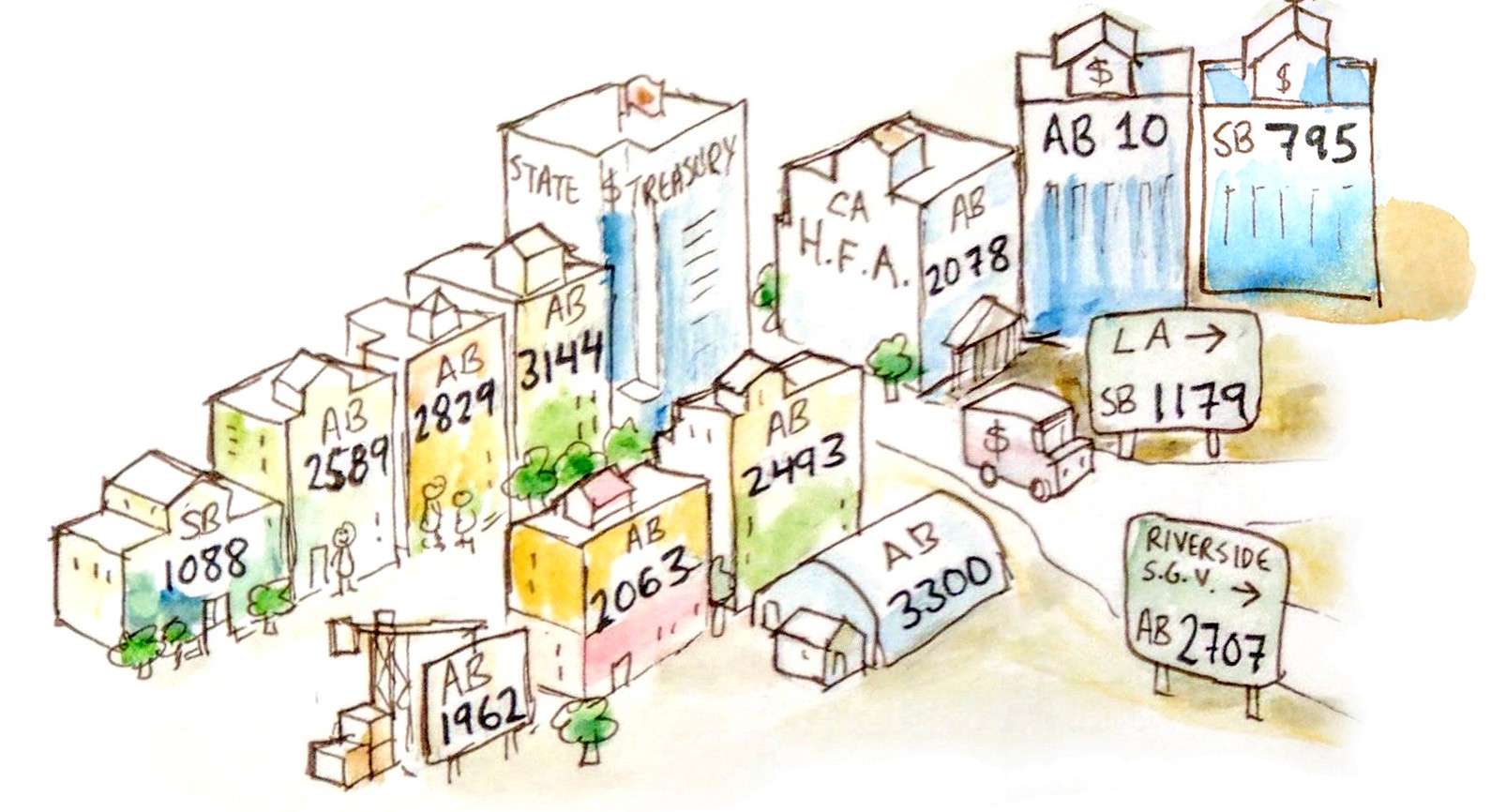
SB 79 makes SB 9 look like child’s play. In particular, developers could turn the Palisades into a miniature Miami Beach, a Sunset Boulevard skyline of 7, 10, and 15 story steel and glass apartments and condos, all jostling for the same million dollar view. Manhattan on the bluffs.
Altadena could face a similar fate, with hundreds of soulless, cheaply built “stack and packs” rising where there were classic, rambling, 100 year old craftsman, Spanish, and rancho style houses.
Don’t think for one minute it’s not possible, even likely. SB 9 is but one bullet in a vast magazine.Below is an actual building that was proposed in Santa Monica under a different density law three years ago. The picture is the architect’s rendering. If SB 79 passes, buildings like this will spread like poisonous mushrooms in single family and low density multifamily neighborhoods statewide — with rebuilding communities like Pacific Palisades and Altadena hit early and hard. Newsom’s executive order leaves this as a very real possibility.
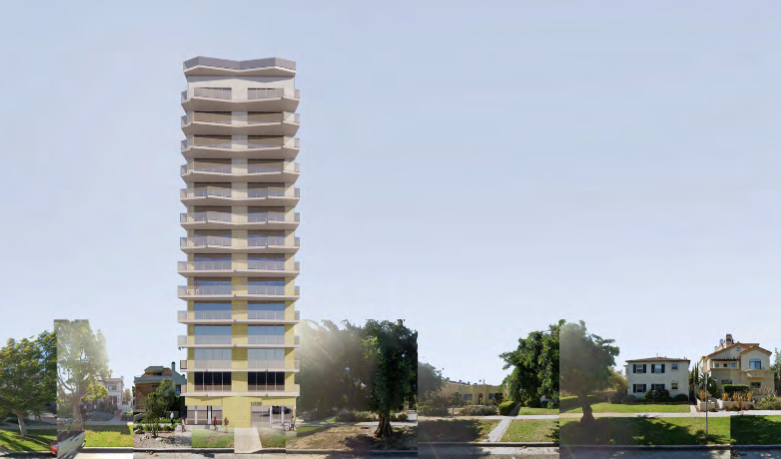
This was a real proposal, 18 stories with a total of 200 studio, one-bedroom, and two-bedroom units, in a low density single family and small multifamily neighborhood, with less than one parking spot per unit. Downloaded from Santa Monica Planning Department.
The governor’s order is doublly telling, because by suspending SB 9 he is reverting to the status quo ante 2021. In other words, he is giving power back to the city and county of Los Angeles to determine how best to rebuild Pacific Palisades and Altadena.
Which raises the obvious question, which should be blared over every op-ed page in the state: Do other communities have to wait until they too burn to the ground to obtain relief from misguided legislation? Do they have to wait for an earthquake, a landslide, or a tsunami?
Consider Eagle Rock. L.A. Metro is planning a $350 million, 16 mile public transit project called the NoHo to Pasadena Transit Corridor. In Eagle Rock, the project would convert Colorado Boulevard from two lanes of traffic in each direction to one. The inside lanes will be replaced by dedicated bus-only lanes called “bus rapid transit.” On the outside of the remaining traffic lanes will be, of course, protected bicycle lanes to serve the 0.8% of (overwhelmingly young, healthy, college educated white male) people bicycle in L.A.
Here’s a section of the plans Metro’s board approved unanimously in April 2023. Not only will the project result in a traffic hellscape, look at the image below.
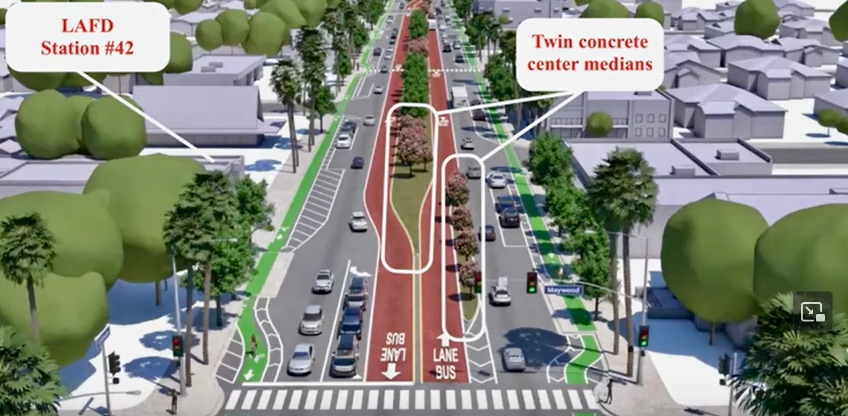
Your eyes don’t deceive you: The plan, which it cannot be emphasized enough was approved unanimously by Metro’s board, features twin landscaped concrete medians, complete with trees, directly in front of Los Angeles Fire Department Station 42, completely cutting off the station’s vehicles from turning northbound on Colorado. There’s also a conventional bus stop at the south curb of the station’s driveway (it’s the white shaded rectangle in the left of the image). Imagine a red light at rush hour, with a BRT bus in the middle lane, traffic backed up for ten blocks in the car lane, and a conventional bus at the outside lane stop. Station 42 gets a call, but the firefighters and paramedics and EMTs and techs are literally stuck in their driveway, waiting for the congestion to clear.
Station 42 also serves as a fuel depot for five other stations in the area that field a total of 31 emergency vehicles including fire engines, fire trucks, aerials, tenders, ambulances, and light rescue vehicles.
Now imagine that developers start taking advantage of SB 79 and increasing density for a half mile on either side of Colorado Boulevard, adding thousands of new residents, all of whom will be trying to evacuate along a single lane of traffic in a mass emergency.
How is Eagle Rock relevant to Pacific Palisades? Both communities appeared in a September 2021 New York Times analysis of “possible next Paradises,” places with similar populations, density, topography, and road capacity to the doomed northern California town.
So why doesn’t Eagle Rock get relief from SB 9 and other upzoning mandates? Again, does it have to burn down? What about the Oakland Hills, site of the 1991 firestorm that killed 27 people and destroyed nearly 3,000 homes? What about Sonoma County, where the 2017 Tubbs Fire killed 27 people and destroyed 3,673 homes? What about the 7.2 million Californians who live in high or very high fire danger severity zones? Where are the executive orders protecting them, especially as we approach peak fire season?
Scores or hundreds of other communities in high fire danger severity zones (HFDSZs), flood plains, liquefaction zones, and other vulnerable areas remain subject to state upzoning and density mandates, including SB 9. Many more are simply built out. Without massive (in most cases unrealistic if not impossible) new investments in infrastructure and public safety, they’re as vulnerable as the Palisades and Altadena. For some, tragically, it’s only a matter of time. Yet while that doomsday clock ticks, the people who allegedly represent Californians’ best interests have been busy finding ways to shoehorn bigger and bigger populations into areas that in many cases already are overdeveloped, all in the name of profit.
The roads and streets in the Pacific Palisades cannot be widened. The community’s evacuation and emergency ingress capacity is what it is (actually, it’s getting worse, as the city installs bollards, curb extensions, and other “pedestrian features,” all of which further restrict road space in emergencies). Packing more people into that same physical area is a recipe for catastrophe, and for death.

Here’s a swell idea: Even as we’re cramming big apartment buildings into single family neighborhoods in fire zones, let’s narrow evacuation routes so that bicycle riders feel safer. Photo in Paradise, CA, by Christopher LeGras
I don’t know if Newsom’s order is an acknowledgement of that reality or just a political feint. With this governor, it’s often safe to assume the latter. He knows there are other laws. He knows SB 79 is on its way (unless engaged Californians manage to stop it).
Either way, the battles for the futures of the Pacific Palisades and Altadena are early in their first stages. It’s no coincidence that the first SB 9 plays come more than six months after the fires. The adrenaline has worn off. Bureaucratic inertia has set in. For six months survivors have spent countless hours on the phone with city, county, state, and federal agencies, insurance companies, inspectors, private contractors, and the rest. Many have already spent a lot of money. Every families’ experience is different. After half a year, some people understandably are starting to say, “enough.” There will be more.
Thanks to the efforts of people like Councilwoman Park, recovery in the Palisades is accelerating. At the same time, both the Palisades and Altadena need additional protections from unscrupulous developers. Halting SB 9 is a good start. Time is those developers’ best friend and wildfire survivors’/rebuilders’ worst enemy.
As the saying goes, there is no unringing this bell. A logical next step is for either the Assembly or the Senate to kill SB 79. If a law allowing 8 or 10 units on single family parcels is untenable as a matter of statewide policy, a bill allowing 70 or 100 is a non-starter. Newsom should order his staff to conduct a thorough review of all new housing laws from the last eight years and determine which ones should be subject to similar executive orders limiting their implementation in vulnerable areas. Concurrently the Los Angeles City Council should pass the motion Park introduced on Tuesday requiring the city to fulfill its legal obligations to evaluate evacuation routes citywide. The Los Angeles County Board of Supervisors should pass a similar measure applicable to the other 87 cities in the County.
Governor Newsom, your executive order acknowledges what reasonable (read: non-YIMBY) people have been saying for close to a decade now: One-size-fits-all state housing laws and mandates don’t work. The rationale for the entire YIMBY movement collapsed before the ink was dry on your signature. Now, Mr. Governor, take the next steps in protecting vulnerable neighborhoods and communities — like your own, up in Ross. You and your family are every bit as vulnerable as the rest of us.
*SB 79 would allow this level of construction when coupled with density bonus and other incentives that allow developers to add more units in exchange for concessions like including a small percentage of affordable units.

 the all aspect report
Spot on! People choose the suburbs and invest heavily in their homes there specifically to live in the sweet spot between urban crowding and rural isolation. For a good 70% of us, owning our own piece of land is an essential component of home ownership. We cherish the “elbow room” and “peace and quiet and open air” afforded by the suburban lifestyle. It is simply normal human nature to want to avoid being hemmed in, akin to sitting in the middle seat on a 10-hour international flight.
The real solution to the sprawl vs. stack-and-pack dilemma is the win-win afforded by a low birth rate and a gradually declining population. Every community has a population carrying capacity dictated by quality of life as well as mere physical space, and many of California’s southern California and Bay Area coastal cities are already at or near that point.
LikeLike