The federal agency’s decision is the latest example of a near-total official breakdown before, during, and after the historic January 2025 L.A. firestorms

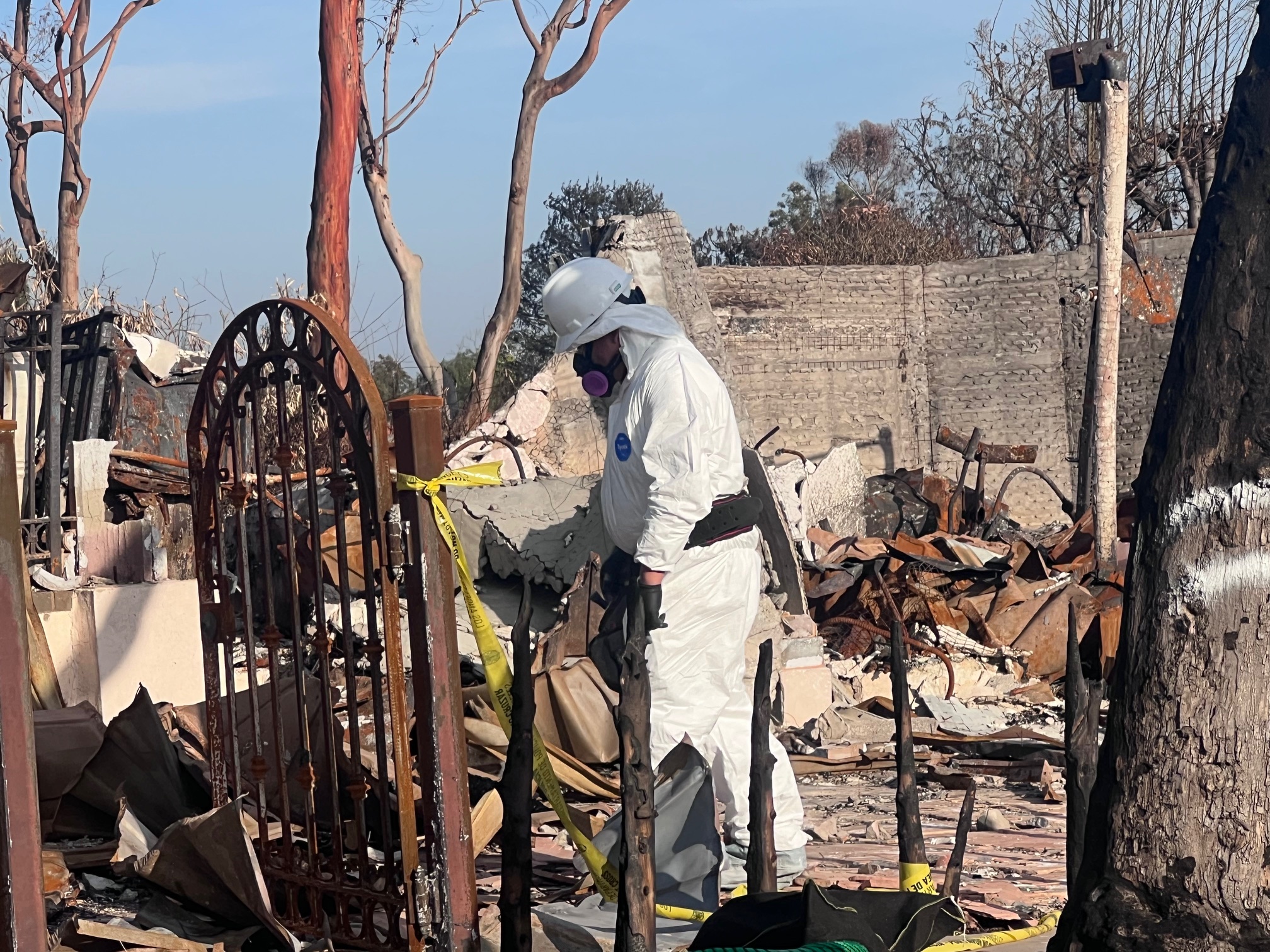
Cleanup workers in Pacific Palisades clad in HAZMAT suits and respirators because, of course, there’s nothing to worry about. Photos by Christopher LeGras
Earlier this month, the Los Angeles Times reported that the Federal Emergency Management Agency (FEMA) was refusing to conduct soil testing in the Pacific Palisades and Altadena in the wake of last month’s wildfires. In response, last Wednesday Nancy Ward, Director of the California State Office of Emergency Services, wrote a letter to FEMA asking the agency to reconsider and proceed with the testing, which is routine after major wildfires.
“Without adequate soil testing, contaminants caused by the fire can remain undetected, posing risks to returning residents, construction workers, and the environment,” Ward wrote in the letter, which was addressed to FEMA’s Coordinating Officer Curtis Brown. “Failing to identify and remediate these fire-related contaminants may expose individuals to residual substances during rebuilding efforts and potentially jeopardize groundwater and surface water quality.”
Brown responded within hours: No. “[Soil testing is] tedious, inefficient, and a barrier to timely clean up [sic] and recovery,” he wrote. He argued that the process would add “several months” to the cleanup process.
Read that again: Soil testing, a standard part of the cleanup process, is a barrier to the cleanup process.
FEMA’s decision is incomprehensible. It’s another example to the litany of official failures at all levels of government before, during, and after the fires. Wildfire smoke can be highly toxic, especially when homes and other structures, along with cars, electronics, and furniture burn. One of many concerns is the number of electric vehicles (EVs) and home and business battery walls that burned. Lithium ion batteries smolder long and hot for hours or even days, releasing toxic chemicals including hydrogen cyanide, hydrogen chloride, hydrogen monoxide, sulfur dioxide, and methane. The smoke also contains heavy metals including manganese, cobalt, and nickel.
Last month, Steve Calanog, the Environmental Protection Agency’s (EPA) incident commander for the Palisades and Eaton fire cleanups, told NBC News “This will be … from our estimation, probably the largest lithium-ion battery pickup, cleanup, that’s ever happened in the history of the world.”
He added, “It is very likely that these batteries were not all consumed in the fire, so now they’re damaged, which means they’re all dangerous.”
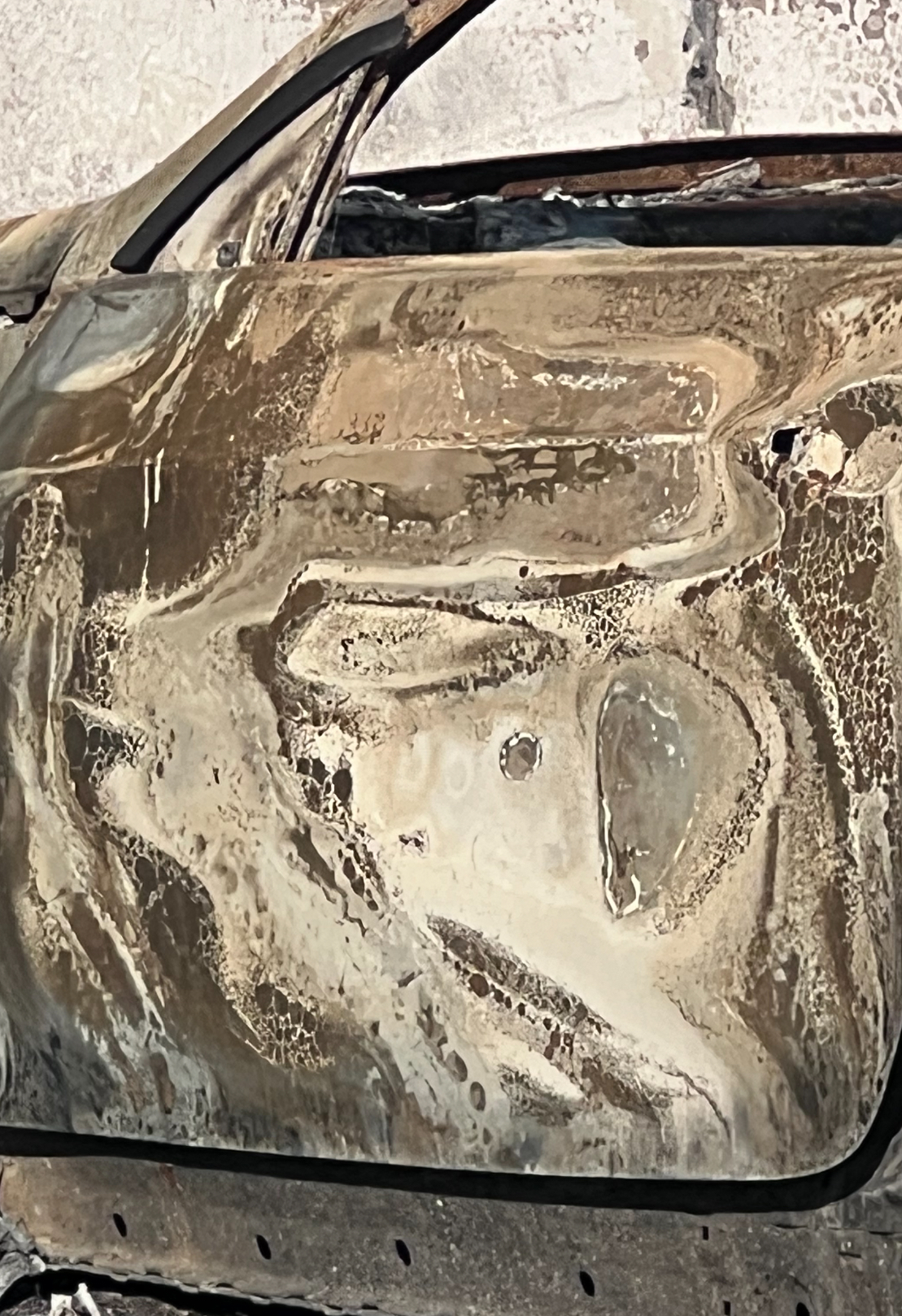
On the door of a burned car in the Palisades, paint melted in a pattern evocative of Edward Munch’s The Scream. Photo by Christopher LeGras.
After the 2018 Camp Fire obliterated the towns of Paradise, Concow, and Magalia in the northern Sierra Nevada Mountains in Butte County, FEMA conducted soil testing. The agency found that approximately a third of the burned properties contained toxic contaminants in excess of state standards after cleanup crews removed six inches of topsoil, the standard practice. The results prompted additional cleanup efforts.
That was more than six years ago, in middle and working class communities where EVs and battery walls were scarce. In contrast, thousands of Palisades and Altadena residents owned those products. Also burned were countless tens of thousands of electronic products like TVs, computers, peripherals, and smart appliances. Other sources of toxic smoke, ash, and debris include house paint, plastics, wiring, cleaning products, even toys. Burning vegetation also can release toxins in the form of pesticides and accumulated pollutants.
Here’s the most astonishing part of Brown’s response to the state’s plea: He wrote, “FEMA does not prevent the State, local governments, or individual property owners from conducting soil testing if they wish to do so. FEMA will not reimburse the costs for soil testing unless testing shows that positive results are clearly attributed to the fires.”
Again, do a readback: “…unless testing shows that positive results are clearly attributed to the fires.” In a letter refusing to conduct soil testing, he acknowledges the possibility of contamination.


Photos by Christopher LeGras
Official after official after official has looked Angelenos in the eye and told us that water isn’t wet. First it was former LAFD Chief Kristin Crowley telling us that predeploying additional resources to potential burn zones wouldn’t have made a difference. Never mind that Palisades resident Steve Foster and his son Colton saved a dozen houses on their block using garden hoses. Never mind that dozens of Palisades residents hired private firefighting companies that saved their and others’ houses. The Chief expected us to believe that hundreds of additional professional firefighters and dozens of fire engines and fire hoses wouldn’t have mattered.
Next up was Mayor Karen Bass, who looked us in the eye and claimed she took her ego trip to Ghana because Chief Crowley didn’t inform her of the impending danger. As I wrote on Friday, she expects us to believe that she alone among 3.9 million residents in the city was blissfully unaware that a historic confluence of dangers was coming into alignment, that she was the only one who hadn’t heard about the National Weather Service’s (NWS) “particularly dangerous situation” warning. A PDS warning literally means that human lives are in danger. Times columnist Steve Lopez pointed out that even if it was true that Crowley didn’t alert Bass, telephones work in both directions.
Now we have a bureaucrat at FEMA, the same good folks who gave us the disastrous response to Hurricane Katrina two decades ago, saying that a key part of the wildfire cleanup process would impede the wildfire cleanup process. But if someone else happens to confirm massive toxic contamination, then his agency will step in and reimburse them for their trouble.
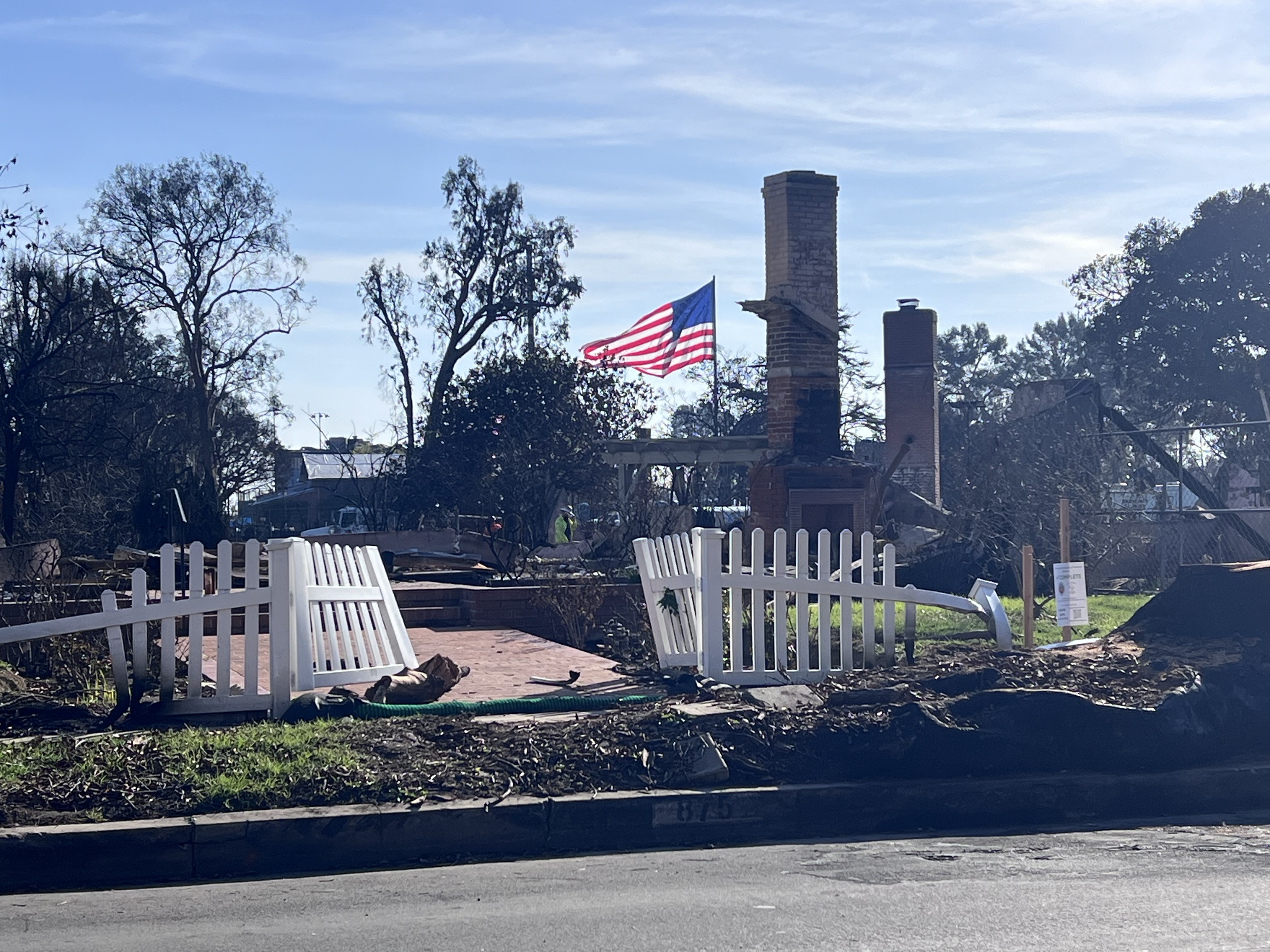
Photo by Christopher LeGras
It’s almost impossible to overstate the near-completeness of the breakdowns in the official preparations for and responses to a historic disaster that anyone with a marginally functional frontal cortex saw coming days in advance. While the flames were still burning thousands of homes and killing dozens of people Crowley picked a political spat with Bass. The two “leaders” spent precious hours in a closed-door fracas when they should have been leading a united response. Bass feuded with L.A. County Supervisor Lindsey Horvath over a press conference (to the DEI folks, by the way, this whole situation is proof positive that black women and lesbians are every bit as capable of screwing the pooch as anyone else. There’s some equality for you.)
L.A. City Councilwoman Traci Park – who, full disclosure, is a friend – is one of the vanishingly few officials who has kept her eye on the ball, been effective, and conducted herself with decorum. Time and again she has stood up, often alone, for her constituents. To paraphrase Colonel Kurtz in Apocalypse Now, if L.A. had two dozen Traci Parks this situation would have been handled very quickly.
Instead, we’ve been plunged into an Upside Down where water isn’t wet.

 the all aspect report
We helped a friend clean her lot after the Tubbs Fire in 2017. There was a company that did the toxics analysis and soils testing and organize the cleanup then done by another firm. All of this was paid by her insurance. The road was private and dirt so no costs to the city. FEMA did nothing. Perhaps they would have if she had been uninsured.
The costs to the city of rebuilding infrastructure will be staggering. Biden tried to get some money set aside but the Orange Nutcase will make every penny a wound to the soul. California will pay for non-obeisance.
LikeLike