
In June the University of California, San Francisco (“UCSF”) Benioff Homeless and Housing Initiative released a report entitled Toward a New Understanding, which it called a Statewide Study of People Experiencing Homelessness. Unfortunately, the nearly 100 page document, which took some 40 people with advanced degrees more than a year to complete, is the opposite of “new.” Bereft of novel insights, it airbrushes the crisis to fit the establishment narrative. It’s an old sow wearing new lipstick. The report amounts to a profound disservice to housed and homeless people in California alike.
We mean “airbrushed” literally: The cover of the report features about 30 pictures of homeless people. While the report purports to focus on so-called “hardcore” homeless – people living for extended periods in places not fit for human habitation such as sidewalks, parks, other public spaces, vehicles, or abandoned structures – virtually everyone on the cover looks robust, healthy, sober, well-dressed, recently showered, and clear-eyed. The pictures appear to have been touched up, airbrushed. Virtually no one in the montage bears any resemblance to the individuals millions of Californians encounter every day in illegal encampments in their communities.
The pictures constitute what gamblers call a tell. Though the report nods to the prevalence of addiction and mental health issues in the homeless population, it downplays those decisive factors. Instead, the authors repeat the narratives that most homeless people in California are not just from California but from the communities in which they’ve landed, and that housing costs are the primary driver of the crisis. As we’ll see, both narratives are false.
The study is earnest but unserious, riddled with methodological flaws and logical inconsistencies. It makes so many unexplained, unfounded assumptions that the entire product amounts to one giant confounder.
The harm the study does is not abstract or theoretical. Here’s how the New York Times reported it: “A New Study Paints a Different Picture of Homelessness in California: Researchers found that homeless people in California were often living in poverty within the state, until they suddenly lost their home.”
Virtually no one “suddenly” loses their home. California has tenant protection laws that apply to most residents, and most cities have additional local protections. The legislature increased those protections in the 2019 Tenant Protection Act, and added still more during the pandemic. Residential foreclosures are even more arduous. You won’t find many people in California who “suddenly” woke up homeless one morning.

Nevertheless, the narrative is the one the establishment, which profits mightily from the crisis both financially and politically, has pushed for more than a decade: People living on the streets, languishing in their own filth, victimizing each other and people who live in surrounding neighborhoods, hopelessly in thrall to the worst narcotics human beings have ever created, screaming at demons they alone can see, are our “unhoused neighbors.” They could be any of us.
No, they could not.
While California undeniably has a housing affordability crisis, that crisis has little to do with hardcore street homelessness. Spending nearly 100 pages protesting otherwise results in bad policies, misallocated resources, and ultimately, more human suffering.
In a quote to the Times the study’s lead author, Benioff Director Dr. Margot Kushel, inverts reality. She says, ““Everything in their life gets worse when they lose their housing: their health, their mental health, their substance use.”

Photo: ABC7 (via YouTube)
Dr. Kushel gets the logic perfectly reversed. It’s more accurate to say, “Everything in their life gets worse when they start using substances: their health, their mental health, and eventually their housing.”
There’s another tell in the study’s introduction. The researchers cite a book called Homelessness is a Housing Problem. They found a book whose title anticipates their conclusions. This is a study irredeemably poisoned by confirmation bias.
Here are four of the biggest flaws, which collectively render the entire exercise meaningless.
Problem #1. The study is methodologically incoherent
The UCSF researchers noted, “The research team used best practices to recruit a representative sample of all adults experiencing homelessness in California, whether they be young or old, in family units with children or single, sheltered or unsheltered, and using services or not.” The notion that a “representative sample” of all homeless people in any community, much less in a state of 40 million people, is possible is a threshold flaw. It’s serious enough to taint all “data” that follows.

There is an emerging realization that homeless people fall into distinct cohorts, which can be thought of as “tiers.” Different tiers have drastically different experiences and reasons for falling into homelessness. They need different interventions to escape homelessness. Tragically, some never will. But the number of people who genuinely require “permanent supportive housing” is relatively small, or at least it should be. Setting aside the fact that the words “permanent” and “homeless” should never be uttered in the same sentence, aside from people with severe, lifelong mental illness and hardcore addiction, the goal of homeless policy should be to restore as many people to self-sufficiency as possible. For the vast majority of people who fall into homelessness the situation is temporary, albeit in many cases it lasts longer than it should.
Again, an overwhelming majority of hardcore homeless suffer from serious and severe mental health and addiction issues (this is one data point the study gets right, as discussed below). However, we need to contrast individuals in that tier with, say, a young woman who has a full-time job but who recently started to live on a friend’s sofa due to an abusive partner, or the family about to lose their home due to unexpected illness and medical bills. Lumping these wildly different experiences can be into a collective “representative sample” is absurd on its face.

Photo courtesy NBC4
Notably, the study fails to define or outline those “best practices.” Just saying it is meaningless. However, the report reveals how overly simplified the underlying research was. For example, the researchers divided the 58 counties in California into eight regions. Why not seven? Why not nine? Why not a dozen? The logic behind the geographic decisions is not explained.
Some of those decisions appear arbitrary to the point of geographical incoherence. The researchers put Monterey and San Diego Counties in the same region, which is nonsensical. Los Angeles is the only country that is its own region, separate from “Central Coast and Southern California.” In reality L.A.’s homeless population is dynamic, with people often moving between and among L.A., Ventura, San Bernardino, and Riverside Counties.
Plumas County is considered “Inland California,” but Butte, Yuba, Sutter, and Colusa Counties are in “Northern California” even though all are south of Plumas. Alameda is part of the “Inner Bay Area” while Contra Costa is in the “Outer Bay Area,” despite the fact that it’s part of the Bay Area Rapid Transit system. Likewise, Santa Clara County is “Inner Bay Area” while San Mateo County is “Outer Bay Area,” even though the latter is closer to San Francisco and includes most of the western shore of the Bay. The state’s southeastern most county, Imperial, is considered part of “Inland California,” which includes Butte County nearly 600 miles north. Finally, even though Riverside, Orange, and San Bernardino Counties all are north of Imperial, they are in “Central Coast and Southern California.”
Suffice it to say, one gets the sense that the researchers don’t often leave the UCSF campus in San Francisco.

After dividing up the state, “[u]sing a variety of data inputs to choose counties within a region that would allow us to draw conclusions about all adults experiencing homelessness in California, we chose one county in each region (Figure 1). With these methods, the counties together stand in for every county across California.”
Read that again: “The counties together stand in for every county across California.” What does that even mean? The extrapolations stretch logic past the breaking point. And again, the “variety of data inputs” are never described.
Nevertheless, the researchers conclude with great confidence that, “the sample accurately represents all adults experiencing homelessness regardless of service use, living situation, family structure, or language spoken.” This is patently absurd.
Problem #2. The researchers exclusively used self-reported data – no independent confirmations of any kind were conducted
Here is a hard fact: Homeless people tend to lie. A lot. That’s not a judgment. Lying is a survival mechanism, both from an emotional and experiential standpoint. Hardcore homeless in particular often weave elaborate tales about their lives before they ended up on the streets. Some lie because they have lost touch with reality altogether. In many cases lying is a way to seek sympathy and deflect criticism and animosity from residents who resent the fact that criminal vagrants from the other side of the country feel entitled to roll up to the Golden State and say, “gimme.” Lying can be a way to ensure they receive benefits from government and nonprofits in their chosen communities.
Last year we interviewed a group of homeless people living in Westminster Park in Venice. One of them, originally from Salt Lake City, had served 18 years for second degree murder. In 2003 he stabbed another man to death on the Venice Boardwalk. The man vehemently claimed it was “self defense.” Of course, one doesn’t do nearly two decades in ADX Florence for self-defense. He also claimed to be a direct descendant of Brigham Young. Another man, from Tennessee, claimed he became homeless because the state government had waged a “years long conspiracy to destroy my life,” a conspiracy that involved the state police and the FBI. He, too, had been in prison.
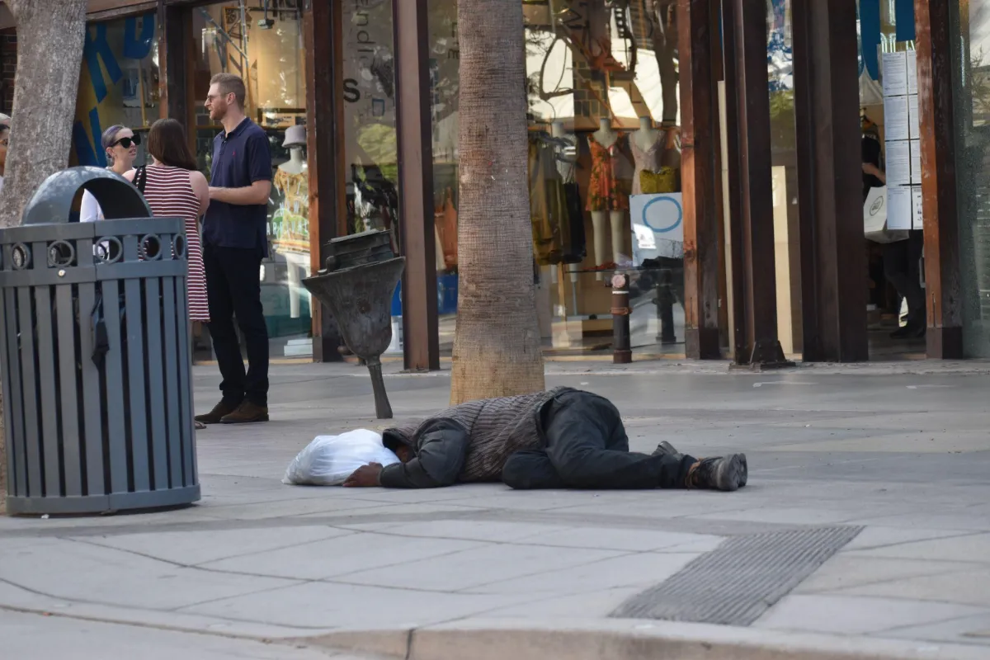
Homeless people also are savvy. Again, it’s a survival mechanism. Hardcore homeless know that the correct answer to the question, “Are you from California?” is “yes.”
All of which is why one should take homeless people’s stories with a generous scoop of salt. Unfortunately such healthy skepticism is absent from the Benioff study.
The researchers noted that, “Throughout this report, we use vignettes, drawn from our in-depth interviews, to help readers understand the experience of study participants. A widely-used approach for illustrating themes in qualitative research, such vignettes draw on a composite of several participants’ common experiences. We created composite experiences to protect privacy and to elucidate the range of experiences shared by multiple participants.”
Not to put too fine a point on it, but this sounds more like a bad Hollywood pitch meeting than serious, data driven statistical analysis. Not only did the researchers take respondents’ answers at face value, they added the additional confounder of their own opinions as to what stories from multiple peoples’ experiences to include in the “vignettes.”
Based on this hopelessly flawed methodology the researchers conclude that, “Ninety percent of participants became homeless in California, having been last housed in the state. People who experience homelessness in California are Californians. Three-quarters (75%) of participants lived in the same county where they were last housed; 3% were homeless in a nearby county within the same census region. Eleven percent stayed within California, but lived in a different census region from where they lost their housing.”
“Last housed” in a given location is not synonymous with “from” there, yet this is a central part of the narrative about California’s homeless crisis. By camouflaging the real transience issue, it does incalculable harm by supporting inappropriate policies that assume stable populations.
A quantification of just how migratory this demographic is can be illustrated by the experience of Santa Monica. Between 2009 and 2013 Santa Monica reported approximately 700 homeless individuals in its Point-In-Time (PIT) counts. A 27% spike to 900 individuals was reported in 2013, the year after the Metro Line light rail was completed and began service.
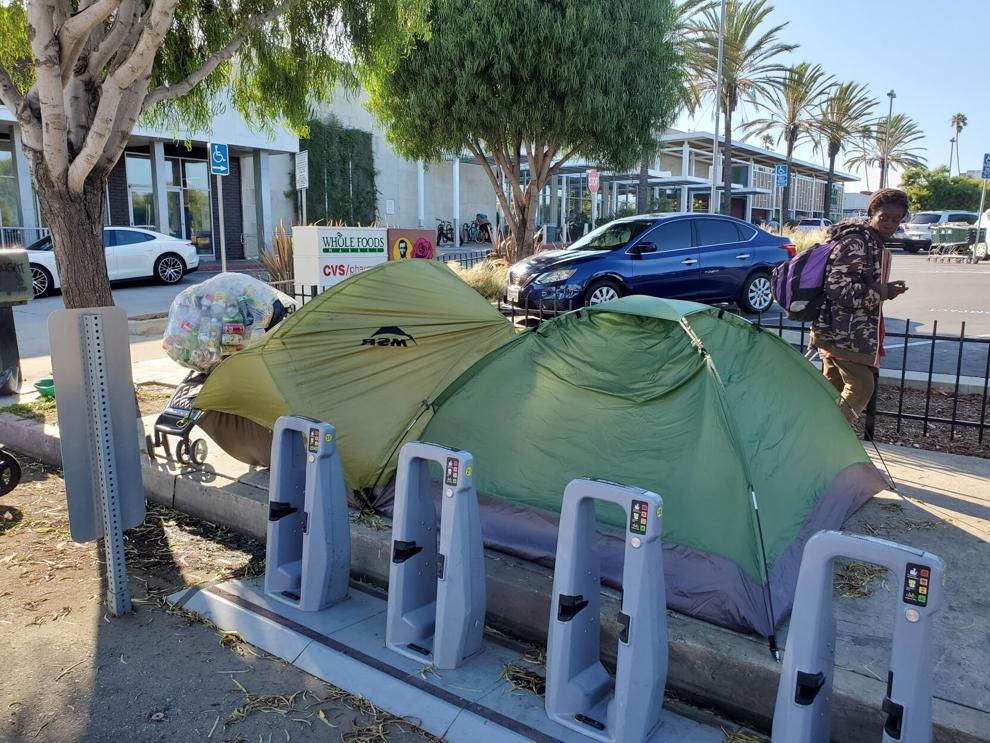
Photo: J.M. Arnold
Separately, the federal Homeless Emergency Assistance and Rapid Transition to Housing (HEARTH) Act, enacted into law on May 20, 2009, requires all continuum of care to maintain a Homeless Management Information System (HMIS) with the capacity to collect unduplicated counts of homeless individuals and families from service providers. Using available data, when comparing Santa Monica’s PIT counts with the totals in the HMIS for the years 2017 to 2020, we find that the average duration of a homeless person’s stay in the city is just under two months.
The city has acknowledged that transiency is an important issue. Yet official policies continue to assume that 900 individuals are permanently homeless Santa Monicans. The same people, year after year. Such policies are inappropriate and ineffectual. Misguided interventions mean that for however long they are in the city, and from wherever they may have arrived, they will not receive the actual interventions — including, when appropriate, bus tickets back home — they need. Meanwhile, housed residents continue to live with the risks attendant to the behavioral issues of this demographic. Everyone loses.
Santa Monica is not unique. As far back as 2007 the San Francisco Chronicle, quoting the director of that city’s homeless services agency, reported that a third of the city’s homeless were from other states. The agency’s director said that he was “astounded” at the number of homeless people arriving from out of town.
Numerous reports over the last 15 years confirm that other states actively ship their homeless elsewhere, with a majority landing in California (with 12% of the nation’s population, California accounts for a third of the homeless population and more than half of the unsheltered homeless population) . Last month the mayor of Anchorage, Alaska proposed sending that city’s homeless to California. He did not pull the idea out of thin air.
In 2019 Governor Gavin Newsom, a former San Francisco mayor, asserted that “most” of that city’s homeless came from out of state, specifically Texas. Overall, he said, the “vast majority” of the city’s homeless were from out-of-state. Though he was predictably pilloried by the press, he is in a position to understand the dynamics of the city’s homeless crisis.
A 2017 investigation by the UK Guardian demonstrated the extreme mobility of homeless people nationally. There is no reason to think that California somehow is unique in having an almost entirely home-grown homelessness crisis.

The transiency goes both ways. Nearly two decades ago San Francisco launched Homeward Bound, a program that provides homeless people with bus tickets and support to return to their families and hometowns in other states. By 2020 more than 11,000 homeless people in San Francisco had returned home. The supposedly authoritative Benioff study is silent on these realities. Why?
Along with data and reporting, on-the-ground experience also calls into question the Benioff report’s conclusion. Of that group of about 20 homeless people in Westminster Park a dozen reported they were from out of state. They came from Utah, Colorado, Tennessee, Arizona, and Arkansas. Two more had arrived from out of state and become homeless after arrival. One man said that he was returning to Colorado literally the next day. In other words, of 20 homeless people only six were from California. Of those, four were from L.A. and two were from elsewhere in the state.
At another encampment, at Reed Park in Santa Monica, of 10 homeless people interviewed five were from out of state and five were from another county (of those, it’s likely several ultimately originated from out of state). None were originally from Santa Monica.
Problem #3. The researchers confused symptoms and causes of homelessness
Just as the authors inverted the relationship between addiction and homelessness, they conflated other factors. For example, they concluded that “[h]alf (52%) of participants noted a lack of documents, such as State-issued identification cards and birth certificates, as a barrier to finding housing. Participants could not afford to replace these, nor did they have access to transportation or other resources to start the replacement process.” That means 48% did possess such identifying documents, but the researchers did not bother to check them against the interviewees’ self-reported origin status.
If someone is in such bad shape that they cannot keep track of and/or replace their basic state identification card, the card is probably not the problem. Cost is not an issue, as state law enables homeless people to waive the replacement fee. Assistance is available at emergency shelters, nonprofit field offices, and by calling 211. Transportation as a barrier to obtaining legal ID likewise is a red herring, as homeless people routinely ride public transit for free. They also can apply for state-issued identification cards online. That means using a smartphone or going to the local library – and a large majority of hardcore homeless have smartphones. Homeless people have the option of using a landmark as their primary residence and can sign up to receive mail, including a new ID, at nonprofit offices.
In the last year California issued ID and driver’s licenses to over 1 million undocumented immigrants. By definition these individuals do not have birth certificates or other supporting documents – ergo, “undocumented.” Yet they were able to obtain their basic identification.
The fact is, many homeless people are content to “fly beneath the radar.” They may be trying to escape criminal histories or avoid being found by an abusive domestic partner or family. Some simply don’t want to bother. And, of course, many are from out of state and do not want to change their official residence.
None of this is to suggest that it’s easy for an unsheltered homeless person to obtain or replace their ID. But considering the realities, one has to be either catastrophically irresponsible or helplessly non-functional to not be able to obtain a basic form of ID at all. This is a prime example of the Benioff researchers confusing cause and consequence.

Photo: Fox 11 (via YouTube)
Problem #4. The researchers cherry picked interviews and results
There is one area in which the report is correct: “The majority [of homeless] (82%) reported a period in their life where they experienced a serious mental health condition …. Nearly two thirds (65%) reported having had a period in their life in which they regularly used illicit drugs. Almost two thirds (62%) reported having had a period in their life with heavy drinking.”
Frankly, the study could have concluded right there. Yet rather than drill down into the core issues of mental health and addiction the researchers acknowledged them, then glossed over them. There is no mention, for example, of how many homeless people they were unable to interview because of intoxication or mental health episodes. No mention of how many encampments were skipped over entirely due to safety and/or health concerns.
In absence of any information in the final report to the contrary, common sense suggests the researchers only talked to people who were willing to be interviewed, who could hold a conversation for 30 or 45 minutes, who were non-threatening, residing in relatively safe places, and who were not so disheveled as to be approachable. This excludes a substantial proportion of “hardcore” homeless and badly skews the final results.

Photo: J.M. Arnold
The cherry-picking obscures another key metric: The extent to which many hardcore homeless are housing resistant. Stories abound of city and homeless nonprofit employees offering shelter and services only to be declined in a majority of cases. This is particularly true of homeless people with addictions, who simply don’t want to live in a setting in which they cannot indulge. Likewise, homeless women often refuse coed shelter situations, and with good reason: Violence, particularly sexual violence, is endemic to homelessness. A survey by the National Health Care for the Homeless Council revealed that 49% of homeless people reported being the victim of a violent attack in the past year.
In San Francisco, one of the few locations to document the issue, Mayor London Breed noted that, “city data from the encampment clearance team that shows people refused referrals for shelter in a majority of thousands of engagements over the last couple of years.” (emphasis added)
Yet the study is silent on this issue. There is no indication that the researchers ever asked the interviewees whether they had recently been offered shelter and if they’d declined it. Quite the contrary: Again accepting homeless people’s self-reported answers at face value the researchers found a “high level of interest in obtaining housing.” Unbelievably they identified homeless peoples’ “criteria” for obtaining housing. Criteria included easy access to their “social networks,” the ability to have pets, romantic partners, and/or friends live with them, and lack of behavioral restrictions. Many expected housing to be in the communities in which they preferred to live, regardless of how long they had been there.
This is, in a word, madness. Over the years countless tens of millions of soldiers, sailors, workers, immigrants, college students, exchange students, summer campers, and others have lived with people they met the day they moved in. As for living where they want, the vast majority of Americans make compromises at some point in their life. If we had our druthers, we’d live in a Bel Air manse. No one has an absolute right to live wherever they want. People’s homes by definition are the result of balance and compromise.

Encampments outside the Westchester pool block parts of the entrance.
Do the researchers truly believe that homeless people are a unique cohort who have the right to demand special treatment? To only “accept” housing that meets their long list of criteria? They are being offered a free place to live. Beggars, as the saying goes, cannot be choosers.
The result is pure propaganda
Why does the Benioff study so vehemently and systematically deny the fundamental highly-migratory nature of homeless people in California? Why did the researchers work so hard to establish them as communities’ “suddenly” homeless unhoused neighbors? Why do they so thoroughly downplay the core issues of addiction and mental illness.
The lack of data ensures that none of the policies – and none of the money spent – actually addresses the real problem. It ensures the real problems – mental illness, addiction, desperation – are never addressed. It ensures the crisis will not only sustain but grow.
Part of the answers to these questions can be found in the recurring messaging of homeless “advocates” (clearly the Benioff researchers fall into this category) that permanent supportive housing is the only solution. Other options are decried as nothing short of inhumane. Yet these same “advocates” – well-compensated nonprofit executives, lawyers, consultants, politicians, and academics – who claim the moral high ground apparently are fine with allowing this unsheltered population to languish, deteriorate, and die in the streets while they wait for permanent housing that takes years to materialize, if it ever does at all. Apparently they are fine with homeless people being victimized by other homeless as well as criminals and organized crime operations that prey on them and use illegal encampments as cover. Inhumane doesn’t begin to describe it.

Zone 5 encampment cleared (Venice Current Staff)
These are huge problems, because “advocates” are the central interface between policymakers and street populations. As noted at the outset, Toward a New Understanding offers nothing new at all, but reinforces the false, failed narratives that are so profitable to places like the Benioff Initiative. They are getting paid to push policies that kill people. Let that sink in.
And profitable it is, to a wide range of actors. In addition to the “advocates,” real estate developers cash in with brand new apartments and refurbished units in repurposed buildings under the permanent supportive housing approach bolstered by propaganda like the Benioff study. In Los Angeles and other large cities such units can cost upward of $800,000, and in some cases more than $1 million, for a small one bedroom. Never mind that in many cases the resultant stock is rarely permanent or supportive, and often barely qualifies as housing.
For example, the boutique 294-room Mayfair Hotel in downtown Los Angeles was converted into homeless housing during the pandemic. In the two brief years that program ran, the hotel suffered over $11 million in damages from unruly tenants who obviously were not getting supportive services to help turn their lives around. Not to be deterred, the City of L.A. is now buying the facility for $83 million. That’s $94 million in taxpayer money, plus whatever it will cost to operate, maintain, and repair it year to year.
The homeless crisis also seems to be a bureaucracy expansion, consultant compensation, and real estate acquisition program. The L.A. City spend has increased from $10 million in 2013 to a proposed $1.28 billion in 2023. That represents a compound annual growth rate of 62%. The 2023 spend works out to $27,700 per homeless person, almost 90% of Los Angeles City’s median 2021 income of $31,800. How much of this money actually gets to the street is anybody’s guess. Meanwhile nonprofit executives and managers at city and county bureaucracies collect healthy six figure salaries.
Here’s the thing: If California actually solved the homeless crisis, all those managers, executives, bureaucrats, lawyers, consultants, and academics (including the 40 who produced a transparently fraudulent Benioff study) would have to find new jobs. And no one in their right mind puts themselves out of a job, least of all a cushy gig at a nonprofit or in academia.

Which is when Toward a New Understanding finally makes sense. Its purpose is to perpetuate the machine that grinds homeless people into profitable husks. That’s not to suggest that all 40 researchers and authors were working with ulterior motives. Presumably most of them were earnest and sincere. Still, one wonders if deep down they truly believe their own work product.
Because no one with a scintilla of common sense possibly can. Given the facts that we’ve discussed, it is conceivable that 100% of homeless expenditures consist of fraud, waste, and abuse.
While people continue to die and suffer.

 the all aspect report